
Arizona Game & Fish Heritage Fund O&M Resolution Workgroup Meeting Summary, 08/06/14

nazsr_landscapephoto_600webArizona Game & Fish Heritage Fund O&M Resolution Workgroup Meeting Summary, 08/06/14

Attendees: Bob Vahle, Bill McLean, Josh Avey, Beth Woodin, Allen Taylor, Jim Unmacht, Jim deVos, Jim Hinkle, Jorge Canaca, Pat Barber, and Marianne Cox. Not attending: Bob Hernbrode Location: AGFD Headquarters

Meeting Summary:

  • Review of agenda, identification of additional agenda items including:
    • Addition of crowd funding to agenda for discussion
    • Clarification of the agenda: ‘discuss mechanisms/ability/guidance for Commission to consider regarding removal of non-historical structures properties that…’
    • June 16 meeting summary correction to incorporate suggestion to seek repayment of Heritage Fund funds previously swept by legislature to the list of approaches considered.
  • Group reviewed summary of Fiscal Year 13, 14, and 15 costing (budgeted and expenditure) as well as anticipated deferred maintenance costing for Heritage Fund acquired properties.
  • Discussion and agreement amongst group to allow recommend changing recommended modification to 17-298 whereby the Heritage Fund acquisition portion of the fund would change from 40% to 35% to allow for funding Heritage Fund acquired property operation and maintenance costing from the non-acquisition portion of the fund.
  • Discussed recommending amendment of Commission Policy to require annual Commission approval for use of Heritage Fund grant funds towards Heritage Fund acquired property operation and maintenance costing.
  • Discussed the need to utilize an open comment process to identify support for the recommendation to reduce the Heritage Fund acquisition portion from 40% to 35%; it was noted that this work group was established with membership intended to represent stakeholders on this issue and that the expectation is that work group membership should be providing information regarding recommendations to the Commission, expressing positions to the work group and serving as liaisons and conduits of information in support of public process and transparency.
  • Discussed approach and recommended modification to 17-298 such that acquisition may include fee simple title, or any possessory or non-possessory interest in land.
  • Disposal of property that does not carry the Heritage Fund value is already possible albeit cumbersome.
  • Structure removal on existing or future properties was discussed as a suitable recommendation.
  • Recommendation to minimize acquisitions that have structures that would have regular operation and maintenance costs.
  • Discussed approaches and feasibility for use of endowments (long term) and crowd funding and corporate sponsorship approaches in building a privately held endowment fund.

A suite of options to present to the Commission at the September Commission meeting was developed that entail: 1) long term funding generation/savings (solutions), 2) Short term funding generation/solutions, and 3) Legislative changes. See list of options below.

Work group reviewed the objective and tenets put forth by the Commission and determined that they met those objectives to the extent possible. No further meetings are needed.

Action Items:

  • Send list of recommendations for Commission consideration – Marianne Cox
  • Present options developed by workgroup to Commission for consideration at September Commission meeting – Jim deVos

Adjourn


Arizona Game & Fish Heritage Fund O&M Resolution Workgroup Recommendations List for Commission Consideration, August 6, 2014

Long Term Funding Generation/Savings (solutions)

  • Endowment – held by 501(c)3
  • Divest of non-sensitive species value properties (those portions that no longer meet intent of purchase)
  • Remove non-value-added (non-historic) structures from properties
  • Investigate the economic potential of new programs such as a wildlife watching Heritage Fund stamp
  • Modify Heritage Fund language to change acquisition fund percent from 40 – 35% so 5% ends up in IIPAM from where O&M expenditures can be made
  • Modify Heritage Fund language to allow for acquisition via non-possessory language and the divestiture of these properties using same
  • Seek corporate sponsors
  • Develop an O&M assessment with each new property being considered for purchase

Short Term Funding Generation/Solutions:

  • Minimize acquisitions that have structures that need O&M
  • Crowd funding for specific O&M actions
  • Seek legislative refunding of funding swept by prior legislature in 2003 – $10 million from Heritage Fund acquisitions fund

Legislative Changes:

  • Change percentage in Heritage Fund Acquisition fund from 40% to 35% so extra 5% ends up in IIPAM from where O&M expenditures can be made
  • Allow for non-possessory acquisition such as conservation easement and disposal of property or portions of properties by “conservation buyer” under a conservation easement
Love Arizona parks? Then get out there and use them

635528131686761919-VerdeKayak-CVR[Arizona Republic Editorial board, December 8, 2014] – There’s a big difference between idealizing a faraway river and feeling the current beneath your boat. That distinction matters to Arizona’s state parks, and the Arizona State Parks Foundation understands why.

When city folks express support for the state parks, it represents a casual friendship. When people get out there and experience the real thing, it leads to a committed, long-term relationship — a relationship worth working to preserve and enrich.

“The more people we get into the parks, the more people will be actively interested in the parks,” says Bill Meek, president of the parks foundation board. “We need to get people out there experiencing what we’ve got.”

An engaged constituency is essential because politicians have not been good to the parks. Funding was stripped during the recession, and the current budget deficit may lead to more pain.

Lack of funding translates into at least $80 million in capital needs at the 31 natural, historic and archaeological sites that make up the state parks system. In addition to funding to keep the sites safe and well maintained, more than $200 million in capital projects have been requested to provide better experiences for visitors.

The problem is not a lack of public support. Over the years, Arizonans have shown continued support for parks in polls, through surveys and at the ballot box. In 1990, they approved the Heritage Fund, which targeted $10 million annually to the parks from Lottery revenues.

The problem is lack of public engagement. Consider this: Lawmakers stripped Heritage funding from the parks during the Great Recession while letting it continue to flow to the Arizona Game and Fish Department. Hunters and anglers form a strong and active constituency. Lawmakers didn’t ignore them.

The constituency for state parks is much broader and less actively engaged politically.

Enter an idea that could help raise money and public consciousness on behalf of these state treasures.

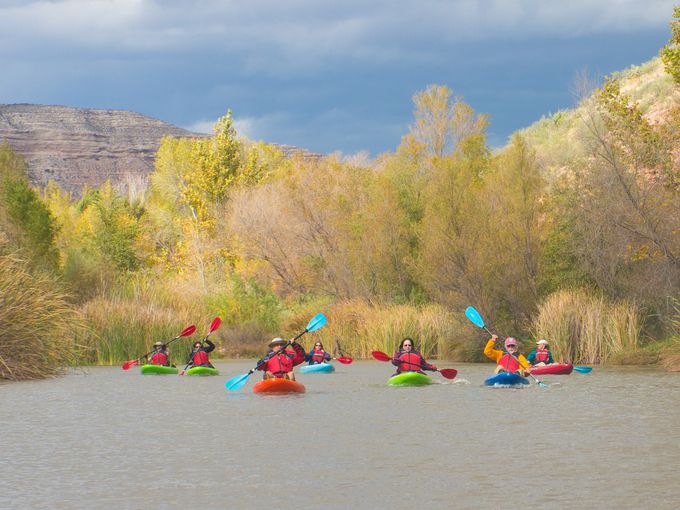
Verde River kayak tours run by the Verde River Institute and the parks foundation include a guide to interpret the flora and fauna, as well as stops at local communities and a tasting session at a winery cooperative.

The $200 fee includes a $115 donation to the parks foundation. Tours this fall brought in about $5,000, which will become seed money to develop a business plan to expand the tours, parks foundation Executive Director Cristie Statler told The Arizona Republic’s Mary Jo Pitzl.

Meek says if the tours are expanded, they could develop a funding stream that lawmakers could not sweep. He says parks systems around the country are using “social enterprise,” an idea that uses commercial strategies to benefit human or environmental needs. That’s the kind of creative thinking our parks need in these tough budget times.

But that’s not all.

Giving people a hands-on experience with resources they had not previously touched deepens their understanding and appreciation. It builds deep commitment. That makes them more likely to “take action and talk to their legislators,” says Doug Von Gausig, director of the Verde River Institute. He leads the river tours.

The more opportunities people have to experience the state parks, the more committed Arizonans will be to speak up for these amazing places.

Source: http://www.azcentral.com/story/opinion/editorial/2014/12/07/state-parks-benefit-engaged-constituency/20058401/

Heritage Alliance Elects New Board & Officers

At its December 5, 2014 board meeting at the Flinn Foundation office in Phoenix, the Arizona Heritage Alliance board of directors elected a new slate of board members and officers. Returning to the board for three-year terms are:

  • Bonnie Bariola, Florence
  • Margaret Bohannan, Scottsdale
  • The Honorable Sam Campana, Scottsdale
  • Peter Culp, Sedona
  • Don Farmer, Scottsdale
  • James Holway, Phoenix
  • Jennifer Martin​,​ Phoenix
  • Kathleen Roediger, Phoenix
  • William Thornton, Tucson
  • Elizabeth Woodin, Tucson
  • Tom Woods, Phoenix

Larry Weigel of Tucson was elected as a new board member. David C. Bartlett of Tucson chose to leave the board after five terms​. Beth Woodin, on behalf of the full board, thanked David for his 15 years of service on the board.

The board then elected the following officers for 2015:

  • President – Elizabeth Woodin, Tucson
  • Vice President – Jim McPherson, Phoenix
  • Secretary – Bonnie Bariola, Florence
  • Treasurer – William Thornton, Tucson

Board members also thanked Janice Miano for her work on behalf of the board.

7 ways to pay for great state parks

[Source: Arizona Republic Editorial] – The ominous clouds hanging over Arizona State Parks need to start raining money. Parks managers struggle to protect valuable resources with no money from the General Fund. Unique remnants of Arizona’s heritage have lost dedicated money streams meant to protect them.

At risk are playgrounds for urban Arizonans and sources of tourism for rural residents. At stake is the chance for your children and grandchildren to travel through time from cave formations that began 200,000 years ago to prehistoric Indian ruins to a Spanish presidio to a territorial prison — and wrap it all up by waterskiing across a man-made lake.

What’s at stake is something irreplaceable and beloved. “It’s time people got their dander up and told the Legislature this is one thing that touches their lives,” says Ken Travous, former executive director of Arizona State Parks.

Here’s what people should tell lawmakers:

Restore the State Parks share of the Heritage Fund. In 1990, voters approved $10 million a year from Lottery revenues for parks. During the recession, lawmakers took that funding. Several attempts to restore it have failed at the Legislature. It’s past time to give it back.

Restore the authority of State Parks to spend money raised from gate fees, gift shops and other money-making enterprises. Park managers used to put increased revenue to work for the parks. Now they need legislative authorization to spend the money the parks make. Beginning in 2003, that enhancement fund was swept by lawmakers and used to supplant General Fund appropriations.

Encourage innovation and resource development through parks’ concessions and development. Parks Director Bryan Martyn is looking at a plan to contract with a single concessionaire for all the state parks. It could result in more investment in the parks if the private contractor serving big money-makers, such as Lake Havasu, also is required to develop resources in less-visited parks. The State Parks Board needs to carefully scrutinize any contract to make sure it serves the public’s best interest.

Recognize the need to create additional sources of permanent dedicated funding. A 2009 Morrison Institute report put the cost of operating and maintaining the parks at $40 million to $44 million a year. The current budget is half that. In addition, the parks have at least $80 million in capital needs. The idea of a surcharge or voluntary donation on vehicle registration has been floated — and rejected by lawmakers — since 2009. It is a painless way for people to add $5 or $10 every year to benefit state parks.

Dedicated means dedicated. Protect funds that benefit the parks from legislative raids or sweeps.

Restore the authority of the State Parks Board to hire and fire the parks director. That position became a political appointee with 2012 changes in the state personnel system. The director now serves at the pleasure of the governor. The parks board lost clout. The director lost the independence of being insulated from a governor’s whims.

Face facts. “No state parks system in the United States pays for itself from earned revenue,” according to the Morrison Institute report, “The Price of Stewardship: The Future of Arizona’s State Parks.” Parks need more than they get from Arizona’s Legislature. They deserve more.

Arizonans demonstrated their support by establishing the Heritage Fund in 1990, and they reiterated that sentiment nearly two decades later when a Gallup Arizona poll released by the Center for the Future of Arizona found that “the state’s natural beauty and open spaces are seen by citizens as our greatest asset.”

It’s time to stop stiffing state parks.

———-

WHAT YOU CAN DO

Arizona State Parks are a resource for today and a promise for tomorrow. But short-sighted funding decisions imperil their future. You can help change that.

  • VISIT. Arizona’s state parks offer dazzling natural wonders, family recreational activities and authentic windows into Arizona’s history and prehistory. azstateparks.com
  • BE A CHAMPION. There’s an election coming up. Ask candidates for state office how they plan to support Arizona’s parks and let them know you want this to be a priority issue.
  • GET INVOLVED. More than a dozen parks have volunteer “friends” groups that provide fund-raising and other services for their chosen park. For information on joining or starting one: azstateparks.com/volunteer/v_foundation.html

Arizona State Parks Foundation is a non-profit that engages in advocacy, fund-raising, and other support. Visit their website at arizonastateparksfoundation.org  The Arizona Heritage Alliance is a non-profit that promotes and protects the Heritage Fund and its goals: azheritage.org

———-

ABOUT THIS SERIES

Arizona State Parks are a valuable resource in great peril. Stripped of funding during the recession, they struggle without state money and stagger under deferred maintenance. Yet they offer open spaces and outdoor recreation for a growing urban population and an economic engine for rural communities. Popular with the public, but lacking political support, funding solutions can help the parks deliver on their remarkable potential.