
Heritage Watch (what has Arizona state government shuttered?)

three-item-thermometer2
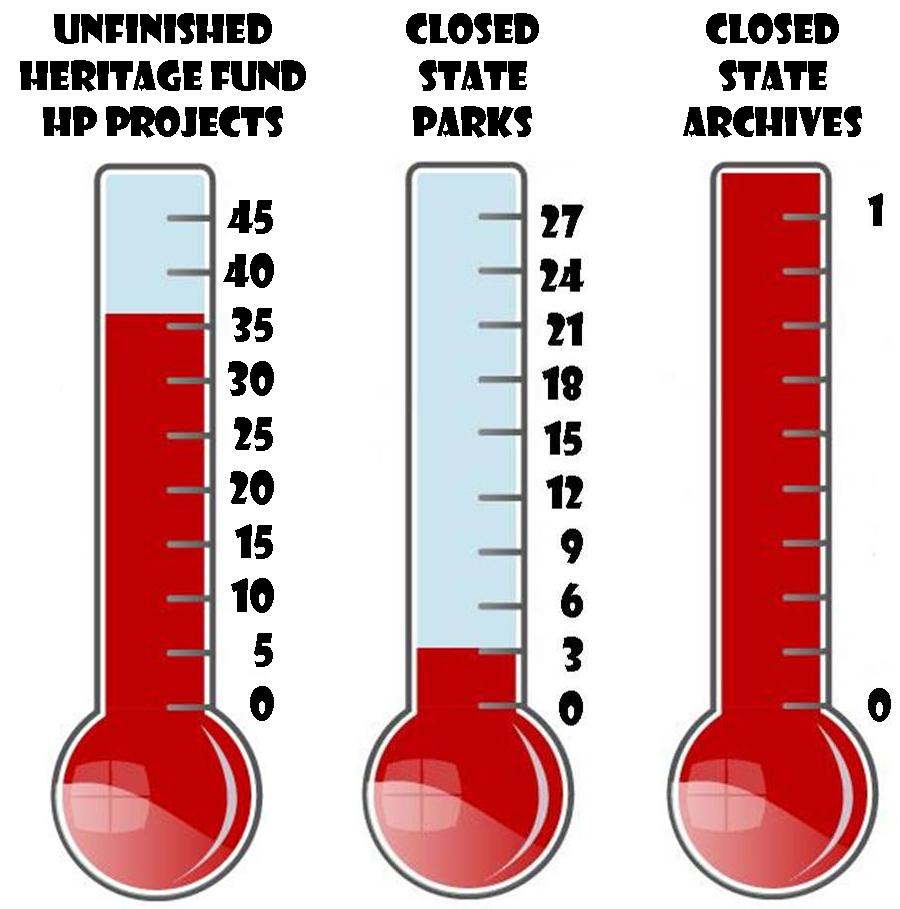
It’s been two weeks since the thermometer in the middle and right have been up.  Jerome, McFarland, and Tonto state parks remain closed.  State Archives patrons and the general public expressed their displeasure to state legislators and archives staff so much so that the facility was reopened two days per week “by appointment only.”

Today we add one more thermometer (the one on the left) to let you know of the plight of 25 Arizona communities that were told by Arizona State Parks on February 2, 2009 to “stop immediately, effective February 1, 2009″ 38 Arizona Heritage Fund Historic Preservation Grant projects, despite the fact that contracts had been signed, materials and supplies were ordered and shipped, and construction work was still underway.  And oh by the way, you won’t get paid for the work that was completed; the State is taking the money back.

Since then, two projects, over 90% complete, were told they could finish their work (and be paid).  The other 36 have been “suspended” until further notice, and individuals, non-profit organizations, and local governments are scrambling to figure out how to pay for the work that everyone agreed to.  Apparently in Arizona, a hand shake and a signed contract mean nothing.

Click here to view a map of the affected projects and Arizona communities.

Arizona biologists begin monitoring collared jaguar

Animal determined to be oldest known jaguar in the wild.

[Source: Arizona Game & Fish] — Early data received from the tracking device on the recently captured and collared jaguar in Arizona is already giving biologists a better understanding of the cat’s movement and foraging patterns.  With nearly a week’s worth of data, the Arizona Game and Fish Department noted that the jaguar moved several miles after collaring to a very high and rugged area that the cat has been known to use in southern Arizona.  The animal has stayed in that general vicinity for a few days with apparent patterns of rest and visits to a nearby creek.  During the collaring, the cat appeared to have just fed on prey, which will aid its recovery and allow it to go for a period of time without feeding.

The satellite tracking technology will allow biologists to study diet and feeding patterns to learn more about the ecological requirements of the species in borderland habitats.  Scientists have also confirmed the identification of the collared animal: The cat is Macho B, an older male cat that has been photographed by trail cameras periodically over the past 13 years…

This conservation effort is funded in part by the Heritage Fund and Indian gaming revenue.  Started in 1990, the Heritage Fund was established by Arizona voters to further conservation efforts in the state including protecting endangered species, educating our children about wildlife, helping urban residents to better coexist with wildlife and creating new opportunities for outdoor recreation.  Funding comes from Arizona Lottery ticket sales.  [Note: To read the full article, click here.]

Arizona House advances state parks funding measure

[Source: Tucson Citizen/Associated Press] — Taking a path that critics said would put lawmakers on legally shaky ground, the Arizona House of Representatives on Thursday gave preliminary approval to a plan to keep threatened state parks open by diverting money from a voter-mandated program for land conservation for open space.  The measure aims to reverse recent state budget cuts that have put numerous state parks at risk of closure.  It has backing from parks advocates but is opposed by the Sierra Club, a lobbying group for environmentalists.  Because it would modify a voter-approved law, the Arizona Constitution requires that the measure both be approved by three-quarters of each legislative chamber and further the intent of the voter-approved law.

The land conservation fund, which provides grants for land purchases by local governments, was authorized under a growth-planning law approved by voters in 1998.  With Thursday’s voice vote, the Republican-backed measure faces an expected formal House vote next week.  Passage would send it to the Senate.  However, passage by the 60-member House is not assured as Democratic leaders criticized the measure during debate Thursday.  Even if all 35 majority Republican representatives vote for the bill (HB2088), a three-quarters vote would require backing from at least 10 of the 25 Democrats.

The legislation would return the $20 million to the land conservation fund in 2012, and supporters of the bill said the state money won’t be missed in the meantime because current economic hard times mean local governments can’t afford their shares of the cost of land purchases.  “We have a great opportunity, instead of putting money aside in a fund that we cannot use,” said Rep. Andy Tobin, R-Paulden.

Rep. Chad Campbell, D-Phoenix, said he supports keeping parks open but not by tampering with a voter-approved law.  “We see this bill as being illegal and not furthering the intent of the voters,” Campbell said.

The Parks Department has already closed three parks — McFarland Historic, Jerome Historic and Tonto Natural Bridge — but eight others are also listed as candidates for temporary closure because of the funding cuts made to close a big shortfall in the current state budget.  The eight are Fort Verde, Homolovi, Lyman Lake, Oracle, Red Rock, Riordan Mansion, Tubac Presidio, Yuma Quartermaster Depot.  [Note: To read the full article, click here.]

2 more Arizona state parks closed; 8 in jeopardy

Tonto Natural Bridge State Park: This geological formation near Payson attracted 87,930 visitors in 2008. It is one of two additional state parks that will close immediately to allow for repairs necessary for visitors' safety, officials said.
Tonto Natural Bridge State Park (Photo: David Wallace, Arizona Republic)

[Source: Casey Newton, Arizona Republic] — Two state parks will close indefinitely and eight more will remain on the chopping block as part of budget cuts approved Friday by the Arizona State Parks Board.  Tonto Natural Bridge State Park and Jerome State Historic Park will close immediately to allow for repairs necessary for visitors’ safety, officials said.  McFarland State Park closed earlier this month for the same reason. Combined with layoffs, the suspension of grants for capital projects and other measures, the park closures will help the parks board pay a $27 million bill to the state due next Saturday.  That figure represents the funds taken by the Legislature last month as part of a $1.6 billion budget fix for fiscal 2009.

Even after the Friday cuts, which were approved on a 3-1 vote, the parks board still must find an additional $3 million in savings by June 30.  That leaves the fate of eight more state parks up in the air: Homolovi Ruins, Oracle, Yuma Quartermaster Depot, Tubac Presidio, Fort Verde, Lyman Lake, Riordan Mansion, and Red Rock.  Whether those parks remain open depends largely on whether the Legislature makes further cuts to state parks as part of the fiscal 2010 budget.  Arizona faces an estimated $3 billion budget shortfall.

Board members were pessimistic about the prospect of keeping all or even most of the eight parks open.  “Don’t leave here today thinking we’re not going to close more parks,” board member Bill Scalzo said after more than five hours of meetings. “We probably will.”  [Note: To read the full article, click here.  Additional news coverage at Arizona Daily Sun, Cronkite News ServiceKNXV PhoenixKSWT Yuma, KTAR Radio PhoenixPayson RoundupSierra Vista Herald, Tucson Citizen.]