“Work with Us, Naysayers” – Opinion by Pat Madden, Chairman, Arizona Game and Fish Commission

Source:  Arizona Central, September 11, 2016

My Turn: Listening to our critics, you’d never know we invest $6 million each89ad1681-20eb-40ea-b511-5d058eaceeb2 year in Arizona to help conserve species.  The Arizona Game and Fish Department conserves and protects the state’s diverse wildlife and promotes safe, compatible outdoor recreation. That’s our mission and we have a long history of successfully managing all 800-plus wildlife species in Arizona.

Political special-interest groups that disagree with the Arizona Game and Fish Commission’s wildlife conservation mission are complaining because we don’t buy into their political agenda.

Our message to agenda-driven ideologues: Work with us.

Listening to the critics, you wouldn’t know that the Game and Fish Commission and the Department invest more than $6 million annually into projects benefiting threatened/endangered species and other non-hunted wildlife. That’s $6 million in on-the-ground conservation, improving the lives of Arizona’s wildlife. We’ll work with any group that will lend a hand.

Here are just a few success stories

Because we collaborated with a coalition of bald-eagle advocates, Arizona’s bald eagles are now plentiful enough to have been delisted from the federal Endangered Species list in 2007.  Since delisting, the breeding population has increased by 30 percent, and the average annual fledgling count has gone from 21 in the 1990s to 55 since 2010. This year, a record 65 pairs of adult eagles produced 78 hatchlings.

Endangered Sonoran pronghorn were on the brink of disappearing from the U.S. by 2002, with only 21 remaining in southwest Arizona. Active management by Game and Fish and our partners has increased Arizona’s herd to more than 350 Sonoran pronghorn, and even more in Mexico.

In 1998, there were no Mexican wolves in the wild in Arizona and New Mexico. Since then, Game and Fish has dedicated significant staff and financial resources to bring the wolf back while working to build social tolerance in local communities.  By collaborating with the U.S. Fish and Wildlife Service and other agencies, Arizona and New Mexico now host 97 known collared wolves and 18 packs, with 42 natural-born offspring last year alone.

We’ll work with anyone to save species.  We also put substantial resources into recovering native fish species with proactive conservation efforts that can reverse the need to list them as endangered. Since 2006, we’ve conducted 300 native fish stockings at 130 sites, helping 18 native species and fostering 112 new native fish populations.

California condors, on the brink of extinction by the early 1980s, now number nearly 430, more than half of which live wild in Arizona, Utah, California and Mexico. Their comeback got an assist from Arizona hunters who voluntarily use non-lead ammo in condor country.

Many other species — desert bighorn sheep, black-footed ferrets, Apache trout, Gould’s turkeys, Chiricahua leopard frogs, and black-tailed prairie dogs to name a few — have benefited from collaborative on-the-ground conservation. We’ve achieved successes because we work with partners who roll up their sleeves and put boots on the ground.

The department will cooperate with any group that values and works toward on-the-ground conservation. We just have difficulty with organizations that focus their resources on rhetoric-laden fundraising letters, scare tactics and litigation. Conservation, like everything in life, only happens when you do the work.

Edward “Pat” Madden is the chairman of the Arizona Game and Fish Commission. Email him at PMadden@azgfd.com.
“Don’t Privatize Our Public Parks” Opinion by William Thornton

Source:  Arizona Daily Star – September 5, 2016

Sometimes a good editorial cartoon says more than an entire column.  A good example, by Jeff Stahler, appeared in the Arizona Daily Star on Aug. 27.  A family listens to ghost stories by the campfire.  Father assumes his scariest pose and says: “And then the decided to privatize the national parks.”

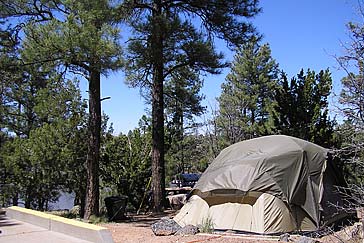
It’s a story that’s becoming reality in state and national parks and public lands.  A complex multifaceted issue with strong proponents on each side.  Good information including pros and cons is available online.  I can’t begin to cover the entire subject but in 30-plus years of camping in state, National Park and Forest Service campgrounds we’ve seen the good the bad and the ugly of public vs. contracted private operation.

Fool Hollow State Park on the edge of Show Low is the gold standard for how a park should be run.  We’ve averagedFOHO_G_02 at least two visits per year over more than 25 years and always found it to be fastidiously clean and well maintained. Best of all we’ve never been bothered by loud music or rowdy behavior.  In mid-summer our favorite high-country campgrounds, Winn, and Apache Trout at Big Lake, are run by the same private company under contract to the U.S. Forest Service.

A noteworthy difference between state-run Fool Hollow and contract-operated Winn and Big Lake is the much larger ratio of campers to camp hosts at Winn and Big Lake. Good for the contractor’s bottom line but what about the quality of camping experience.  It depends on the camp hosts.  Over many years camp hosts at Winn have been some of nicest people we’ve ever had the pleasure of knowing. Friendly, helpful, courteous and conscientious.

At Big Lake it’s been a mixed bag. Camp hosts included one who came on like a marine drill sergeant.  Another required a verbal kick in the fanny to enforce camp ground rules when children drove a go-cart up and down the road subjecting campers to nerve-racking noise and clouds of dust while the camp host did nothing. On another visit an overloaded trash bin stunk so badly that you could smell it half a mile away.

When camping experiences depend on the quality of hosts, we deserve better than luck of the draw whether in state, federal, or contract-operated facilities.  Oversight is the key.  On site-operators will be as good or as bad as the standards they are held to by campground owners, and that would be us. When they take the oath of office, our elected officials accept the awesome responsibility of managing our public lands for present and future generations. When they fail as stewards it’s because we’ve allowed them to.

As we celebrate the 100th birthday of our National Park Service we can be thankful for the foresight of private citizens and elected officials who created a network of protected public lands that’s the envy of the entire world. We must also accept responsibility for the $12 billion of deferred maintenance in our national parks, and many million more in our state parks.  Can private contractors be part of the solution? With effective oversight maybe so; but they must be held to a higher standard than what we’ve experienced.  It’s an election year.  On the presidential level it may be little more than a name-calling contest, but many other state and national offices are up for grabs.  If we want a well-maintained network of parks open and accessible to all now is the time to speak up.

William Thornton is a second-generation native Arizonan, conservationist and outdoor enthusiast. He serves on the boards of the Arizona Heritage Alliance and Friends of Ironwood Forest. Contact him at cactusworld@msn.com

Applications Sought for Arizona Game and Fish Commission

Source: Arizona Game and Fish Department, September 1, 2016.  The Governor’s Office is currently accepting applications for the Arizona Game and Fish Commission. Applications must be received or postmarked no later than 5 p.m. Friday, Sept. 30, 2016. Applications received or postmarked after the deadline will not be considered.

Governor Doug Ducey is seeking members who are well-informed and passionate about Arizona wildlife and its long-term conservation. In accordance with Arizona law, the Game and Fish Commission is required to be politically balanced and representative of all 15 counties (i.e., no more than three commissioners may be from the same political party, and no two commissioners may be residents of the same county).

Therefore, this Commission vacancy is NOT available to registered residents of Apache, Coconino, Pima, or Yuma counties. Residents of all other counties – Cochise, Gila, Graham, Greenlee, La Paz, Maricopa, Mohave, Navajo, Pinal, Santa Cruz and Yavapai – are eligible and encouraged to apply.

Interested individuals may aazgf_logopply by clicking here: Boards and Commissions Application.

For further information about the Arizona Game and Fish Commission and its mission, visit www.azgfd.gov/commission. Individuals also may contact the Governor’s Office of Boards and Commissions at (602) 542-2449.

7 ways to pay for great state parks

[Source: Arizona Republic Editorial] – The ominous clouds hanging over Arizona State Parks need to start raining money. Parks managers struggle to protect valuable resources with no money from the General Fund. Unique remnants of Arizona’s heritage have lost dedicated money streams meant to protect them.

At risk are playgrounds for urban Arizonans and sources of tourism for rural residents. At stake is the chance for your children and grandchildren to travel through time from cave formations that began 200,000 years ago to prehistoric Indian ruins to a Spanish presidio to a territorial prison — and wrap it all up by waterskiing across a man-made lake.

What’s at stake is something irreplaceable and beloved. “It’s time people got their dander up and told the Legislature this is one thing that touches their lives,” says Ken Travous, former executive director of Arizona State Parks.

Here’s what people should tell lawmakers:

Restore the State Parks share of the Heritage Fund. In 1990, voters approved $10 million a year from Lottery revenues for parks. During the recession, lawmakers took that funding. Several attempts to restore it have failed at the Legislature. It’s past time to give it back.

Restore the authority of State Parks to spend money raised from gate fees, gift shops and other money-making enterprises. Park managers used to put increased revenue to work for the parks. Now they need legislative authorization to spend the money the parks make. Beginning in 2003, that enhancement fund was swept by lawmakers and used to supplant General Fund appropriations.

Encourage innovation and resource development through parks’ concessions and development. Parks Director Bryan Martyn is looking at a plan to contract with a single concessionaire for all the state parks. It could result in more investment in the parks if the private contractor serving big money-makers, such as Lake Havasu, also is required to develop resources in less-visited parks. The State Parks Board needs to carefully scrutinize any contract to make sure it serves the public’s best interest.

Recognize the need to create additional sources of permanent dedicated funding. A 2009 Morrison Institute report put the cost of operating and maintaining the parks at $40 million to $44 million a year. The current budget is half that. In addition, the parks have at least $80 million in capital needs. The idea of a surcharge or voluntary donation on vehicle registration has been floated — and rejected by lawmakers — since 2009. It is a painless way for people to add $5 or $10 every year to benefit state parks.

Dedicated means dedicated. Protect funds that benefit the parks from legislative raids or sweeps.

Restore the authority of the State Parks Board to hire and fire the parks director. That position became a political appointee with 2012 changes in the state personnel system. The director now serves at the pleasure of the governor. The parks board lost clout. The director lost the independence of being insulated from a governor’s whims.

Face facts. “No state parks system in the United States pays for itself from earned revenue,” according to the Morrison Institute report, “The Price of Stewardship: The Future of Arizona’s State Parks.” Parks need more than they get from Arizona’s Legislature. They deserve more.

Arizonans demonstrated their support by establishing the Heritage Fund in 1990, and they reiterated that sentiment nearly two decades later when a Gallup Arizona poll released by the Center for the Future of Arizona found that “the state’s natural beauty and open spaces are seen by citizens as our greatest asset.”

It’s time to stop stiffing state parks.

———-

WHAT YOU CAN DO

Arizona State Parks are a resource for today and a promise for tomorrow. But short-sighted funding decisions imperil their future. You can help change that.

  • VISIT. Arizona’s state parks offer dazzling natural wonders, family recreational activities and authentic windows into Arizona’s history and prehistory. azstateparks.com
  • BE A CHAMPION. There’s an election coming up. Ask candidates for state office how they plan to support Arizona’s parks and let them know you want this to be a priority issue.
  • GET INVOLVED. More than a dozen parks have volunteer “friends” groups that provide fund-raising and other services for their chosen park. For information on joining or starting one: azstateparks.com/volunteer/v_foundation.html

Arizona State Parks Foundation is a non-profit that engages in advocacy, fund-raising, and other support. Visit their website at arizonastateparksfoundation.org  The Arizona Heritage Alliance is a non-profit that promotes and protects the Heritage Fund and its goals: azheritage.org

———-

ABOUT THIS SERIES

Arizona State Parks are a valuable resource in great peril. Stripped of funding during the recession, they struggle without state money and stagger under deferred maintenance. Yet they offer open spaces and outdoor recreation for a growing urban population and an economic engine for rural communities. Popular with the public, but lacking political support, funding solutions can help the parks deliver on their remarkable potential.