Arizona weighs privatization for state parks

[Source: AP via azcentral.com]

Lyman Lake State Park is closed. (Photo credit: Arizona State Parks)

Arizona officials might turn over management of two small state parks to private operators so they can reopen the sites that were closed because of budget trouble.

The 28-park state system already uses concessionaires to provide some services but now may go further by turning to the private sector for the actual operation.

The parks system has requested proposals due Sept. 23 for operation of Oracle State Park in southeastern Pinal County and is considering whether to issue a request for proposal for Lyman Lake in southern Apache County.

Ultimately that could result in the parks being operated by private companies, parks Executive Director Renee Bahl said Wednesday.

The move is being viewed with some skepticism by at least one potential bidder.

Arizona lawmakers wrestled with parks-related funding issues throughout their 2010 session, ultimately passing legislation specifically authorizing state officials to contract with public, tribal and private entities to operate parks.

Recreation Resource Management, a Phoenix-based company that operates campgrounds and marinas in about a dozen states, in February offered to take over operations of some Arizona state parks for a year so they could remain open.

Parks officials did not reject the request outright but said privatization was not a “silver bullet.” Instead, they have turned to cities, counties and other public entities, reaching agreements that help pay for continued state management of certain parks and management of others by non-state public entities.

Now, nine state parks remain open under state management, while seven others are being operated by state employees through partnership agreements. Five others are being run by other public entities and six are closed.

Partnership agreements haven’t proved to be feasible with all parks, including Oracle and Lyman Lake, said Renee Bahl, the parks system’s executive director.

“We weren’t able to find a solution for the public sector,” Bahl said of Oracle, which is located near a small unincorporated community of the same name and which closed in October. “Everything is on the table right now. We want the parks to be open for the public and the economy too.”

However, a Phoenix-based company that operates parks in about a dozen states and that previously offered to run some Arizona parks to keep them open to help out the state expressed only cautious interest in bidding to operate Oracle.

“The Oracle RFP is pretty thin gruel,” said Warren Meyer, president of Recreation Resource Management.

The park has many restrictions that appear to undercut its value as a “good commercial opportunity,” particularly as a stand-alone project without opportunities to spread overhead costs over several parks, he said in an e-mail to The Associated Press.

However, Meyer said RMM still might bid to operate Oracle to pre-empt any strategy by parks officials to undercut privatization efforts.

Meanwhile, Cindy Krupicka, president of a booster group for Oracle State Park, said she’d welcome privatization. “I’d just like to see the park open,” she said.

Activists launch effort to defeat ballot proposition on right to hunt and fish

[Source: Arizona Capitol Times]

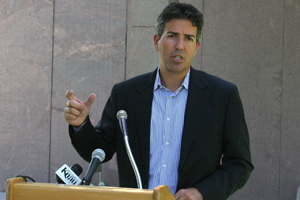
Wayne Pacelle, president/CEO, Humane Society of the US. (Photo by Lauren Saria/Cronkite News Service)

A ballot proposition promoted as a way to safeguard the right to fish and hunt in Arizona would politicize decisions about wildlife by giving the Legislature sole authority, leaders of a new campaign against the measure said Friday.

“It’s just one more bad idea from one of the most dysfunctional legislatures we’ve seen,” Sandy Bahr, director of the Sierra Club’s Grand Canyon Chapter, said at a news conference announcing the effort against Proposition 109.

Authored by Rep. Jerry Weiers, R-Glendale, and referred to voters by the Legislature, Proposition 109 would establish the “right to hunt, fish and harvest wildlife lawfully.” It would prohibit any law or rule that unreasonably restricts hunting or fishing.

It also would give the Legislature exclusive authority to enact laws regulating the manner, methods and seasons for hunting and fishing. Lawmakers could still delegate rule-making authority to the Arizona Game and Fish Commission, which currently establishes policy for hunting and fishing.

Calling their effort Arizonans Against the Power Grab, the state Sierra Club, The Humane Society of the United States and the Animal Defense League of Arizona filed paperwork Friday establishing a committee to oppose Proposition 109.

Wayne Pacelle, president and CEO of The Humane Society of the United States, said that giving lawmakers exclusive authority to make laws involving hunting and fishing would hinder the ability of citizens to put forward their own ballot initiatives, and not just on hunting and fishing.

“Today it’s wildlife,” Pacelle said. “But it could be any other cause in the future.”

Weiers didn’t respond Friday to a message left with the House Republican spokesman. Cronkite News Service was unable to reach representatives of hunting and outdoors groups that registered support for the measure.

Twelve other states include the right to hunt and fish in their constitutions, while Tennessee, South Carolina and Arkansas are voting on similar propositions this year, according to Arizona State University’s Morrison Institute for Public Policy.

Bahr called the ballot measure a “proposition in search of a problem” that would undermine a system that now uses science rather than politics to regulate hunting and fishing.

“The people of Arizona support animal welfare,” she said.

Some provisions of Proposition 109:

  • Declares hunting and fishing a constitutional right of Arizona citizens.
  • Specifies that wildlife belongs to the state and its citizens.
  • Gives the Legislature exclusive authority to enact laws to regulate hunting and fishing.
  • Allows the legislature to delegate rule-making authority to the state Game and Fish Commission.
  • Prohibits any law or rule that unreasonably restricts hunting or fishing using traditional means.
Enhanced by Zemanta

Scottsdale likely to bid on state trust land for preserve

[Source: Peter Corbett, azcentral.com]

Scottsdale is expected to be among the bidders next month for 2,000 acres of state trust land that has been appraised at $44.1 million.

The Arizona State Land Department has scheduled an auction Oct. 15 for the acreage in the Granite Mountain area of northern Scottsdale.

It is a desert area northeast of Troon North between the alignments of Lone Mountain Road and Dixileta Drive and roughly between 96th to 130th streets.

The property is zoned for single-family homes on lots of about 5 acres with other environmental restrictions.

Kroy Ekblaw, Scottsdale preserve director, said the city and the State Land Department have not had any contact with builders interested in bidding on the trust land.

The undulating terrain includes thick stands of desert vegetation, washes and exposed boulder outcropping, he said.

“There are challenges with development in bringing water and sewer services to the area,” Ekblaw said.

Scottsdale has long targeted the area for its McDowell Sonoran Preserve.

The city applied this summer for a grant from Arizona’s Growing Smarter conservation fund to split the cost of the state land, which is priced at $22,043 per acre.

Awaiting grant approval

Last month, the Conservation Acquisition Board, an advisory panel of the Arizona State Parks Board, recommended approval of a matching grant for Scottsdale of up to $25 million.

The Parks Board is scheduled to decide on the grant at its Sept. 15 meeting.

It also will decide on matching grants for Phoenix and Coconino County for land conservation through the Growing Smarter fund.

In a separate auction Oct. 15, Phoenix will be bidding for 1,139 acres of state trust land in northeastern Phoenix.

The parcel, appraised at $25.8 million, is between Lone Mountain and Dove Valley roads from Seventh to 24th streets.

Phoenix wants the land for its Sonoran Preserve. It is seeking to split the cost by acquiring a grant from the Growing Smarter conservation fund.

Coconino County wants funding to acquire the 2,249-acre Rogers Lake Preserve southwest of Flagstaff for $11.75 million.

That state trust land is up for auction Nov. 1.

Land fund may disappear

Scottsdale, Phoenix and Coconino County are tapping into the $123 million conservation fund before it potentially disappears.

If voters approve Proposition 301 on Nov. 2, the state will transfer what’s left of the conservation money to the general fund to balance its budget.

Conservation groups are opposing the raid on conservation funds. Voters approved the Growing Smarter initiative in 1998 to help communities buy land for conservation and to slow urban sprawl.

Scottsdale’s last acquisition for the McDowell Sonoran Preserve was in December when it paid $6.5 million at auction for 400 acres of state trust land north of DC Ranch.

The city has about 15,000 acres in the preserve with a goal to conserve 36,000 acres of desert and mountain terrain.

Enhanced by Zemanta

Obituary: A.C. Williams

[Source: Prescott Daily Courier]

A.C. Williams passed away at his home of 53 years in Prescott, Ariz., on Aug. 31, 2010, after dealing with diabetes and heart problems for several years.

Archie Crouch was born on May 16, 1925, to Archie Andrew and Lizzie (Crouch) Williams in the west Phoenix, Ariz., valley. A.C. was the second child and oldest son of the family. He was born in a house surrounded by cotton fields and was always proud of being a native Arizonan. A.C. spent his early life, during the Depression, working alongside his family on their farm in Gilbert and Chandler.

He would gladly tell stories of how he and his brother, Gerald, would milk cows on their dairy farm before sunrise and going to school. He excelled at school and developed a consuming passion for sports, reading the sports pages of the newspaper, and listening to games on a radio that he hooked up in the milk barn.

A.C. spent many hours riding horses with Gerald and his cousin, Denton Little, across Pinal County between, what is now the Sun Lakes area and the Williams farm southeast of Chandler.

A.C. participated in all the sports teams while in high school, playing basketball, football and baseball, and particularly excelling in track. Upon graduation from high school in 1943, he enlisted in the U.S. Navy and served as a Medical Corpsman in Memphis, Tenn., Atlanta, Ga., and Norman, Okla., mostly working in the clinics and driving an ambulance on the airfields. A.C. was not sent overseas due to his being colorblind, but was always proud of the service he rendered to his country.

A.C. was married to Glendell Gobbel on Christmas Eve of 1945 after hitchhiking from his duty station in Oklahoma to Tempe, Ariz., where the wedding took place. The newlyweds made their first home in Atlanta.

He attended what was then called Arizona State’s Teacher College in Flagstaff and graduated in a record two years, with a degree in political science and history, with a minor in physical education and recreation. While there, he worked at a local motel doing any job he could find to support his young family. A.C. got a teaching job at the new Flowing Wells High School, on the outskirts of Tucson, where farms still bordered the school grounds. He literally laid out the first ball fields at the school. Any and all sports at the school, A.C. coached it. He worked as the school district recreation supervisor for the Parks and Recreation department in the summers in Tucson.

In 1957, A.C. moved his family to Prescott due to his daughter Vicki’s asthma. He was the new Parks and Recreation Director for the City of Prescott and started from scratch, as he was the only staff member, with a few volunteers who helped with various sports programs. His first office was at City Park, now Ken Lindley, under the old bleachers, complete with leaking water on the cement floors. Prescott was just a small town of about 12,000 people, and building the parks was by far the most important thing to him.

A.C. was most proud of building of the first Roughrider softball diamond near Yavapai College, with no bonds or sales tax dollars. He depended on a lot of community support and volunteer hours to complete it, as there was no money to work with.

His biggest achievement and the one he was proud of accomplishing, was that of promoting fast-pitch softball. A.C. had the philosophy of getting the finest quality of teams and players he could recruit for tournament play. A.C. was able to get teams from all over Arizona and California. There were a lot of good competitive teams in the Prescott area in the 1960s at that time, and was in full swing before 2,000 to 4,000 fans on many weekends at Ken Lindley Park.

A.C. and his small staff of one or two people spent countless hours on the downtown plaza, rigging up PA systems for talent shows and square dances in the summer. He was the one who coordinated anything that needed to be done for any public event in the greater Prescott area. It was a common saying around town, “Get A.C. to take care of that,” and he would always go way beyond the call of duty. He was responsible for the Teen Canteen, which he set up for the local teams in Prescott in the late 1950s and early 1960s.

In 1962 A.C. was appointed to the Arizona State Parks Board by Gov. Paul Fannin, reappointed by subsequent governors, and stayed active until he retired in 1984. He was selected as Man of the Year by the Prescott Chamber of Commerce in 1969 and served as the Arizona State Commissioner for the Amateur Softball Association of America, that same year. A.C. also served on the Governor’s Advisory Sports Council by Gov. Bruce Babbit in 1978 and the Prescott Salvation Army presented him with the Humanitarian of the Year Award in 1979.

Throughout the 1970s he toured Arizona softball teams in New Zealand, South Africa, Netherlands Antilles, Puerto Rico, Australia and the Philippines. He and his wife, Dell, made many close friends in New Zealand and kept in contact with them over the decades.

A.C. knew every inch of Arizona and was proud of his knowledge of little known “forgotten” towns throughout the state. He traveled by every mode of transportation, as a member of the Arizona Parks Board, participating in countless dedication ceremonies at new state monuments or parks, cutting ribbons, shaking hands, standing for photographs with various dignitaries. He even took a ride in a stagecoach into Tombstone, for an event, which he always laughed about.

A.C. spent his retirement years from the Park and Recreation office, doing what he loved best, that of being the Regional Director for six states in the Rocky Mountain region and was on the Executive Board for the Amateur Softball Association. His devotion to the development and promotion of softball was boundless. He always loved seeing the kids, especially, take up the sport and succeed. A.C. could name the old-time softball players from the 1930s and 1940s with ease. He was proud of the fact that his great granddaughter, Allyson Jacobson, is active in girls’ softball and obviously loves the sport as much as he did.

A.C.’s footprint is seen everywhere in Prescott and Arizona. His is a lasting legacy that will always be seen in the ballparks, parks and monuments throughout the state, and in the people who knew him.

Survivors include his loving wife, Glendell; and their children, Linda (Phillip Murray) Cates, Vicki Mastriani and Byron Williams. Seven grandchildren include Robyn (Brian) Jacobson, Glenn (Nilda) Cates, Aaron and Todd (Hannah) Mastriani, and Nate, Luke and Tyler Williams. Five great-grandchildren include Allyson and Jared Jacobson, Hailey and Dawson Mastriani, and Scarlett Cates, with a new great grandson due in October. He also leaves a sister, Jo Stricker, of Colorado and numerous nieces, nephews and family members. He was predeceased by his sister June Beck and brother, Gerald Williams, as well as his parents.

Services will be at 10 a.m. on Saturday, Sept. 4, 2010 at the Grace Sparkes Memorial Activity Center (Armory Building) at 824 E. Gurley St., Prescott. Visitation is scheduled from 4 to 7 p.m. Friday, Sept. 3 at Hampton Funeral Home, 240 S. Cortez St., Prescott. Family suggests memorials be made to Arizona ASA, P.O. Box 1850, Prescott, AZ 86302.

Hampton Funeral Home was entrusted with the arrangements.

Please visit www.hamptonfuneralhome.com to sign A.C.’s guestbook.

Enhanced by Zemanta