Kartchner Caverns hosts astronomy night

[Source: azcentral.com]

Stars shine brighter away from city lights. That’s why astronomers look for remote places to place telescopes, and why stargazing events often take place in parks away from towns.

This weekend, Arizona State Parks invites you to spend an evening with astronomer Bob Gent at Kartchner Caverns State Park near Benson.

“He’s . . . an avid astronomer. He’s done it all over the country,” assistant park manager Chris DeMille said.

This is the second year of the event. “Last time we did this, we had five telescopes. This time we’re shooting for a little bit more.”

Visitors will be able to see Jupiter, Venus, craters of the moon, stars and galaxies. Gent is a past president of the Astronomical League and the International Dark Sky Association, and other astronomers will assist him during the event.

Visitors are asked to bring a folding chair and a flashlight covered with a red cap (available at sporting-goods stores). A piece of red cellophane placed over the flashlight beam also works. The event starts before sunset so people can learn a bit about astronomy before the viewing begins. The park’s café is closed at night, so bring snacks and drinks if desired. Bring a sweater or jacket, too.

“We’re at 4,600 feet, so it’s a little more comfortable,” DeMille said.

Kartchner Caverns is known for its colorful stalactites, stalagmites, soda straws and other features. The park is at the base of the Whetstone Mountains, with views of the San Pedro Valley.

The park has two main caves open for tours, the Rotunda and the Big Room. The Big Room is open from Oct. 15 to April 15 and will be closed during this event.

Stargazers can camp at the park’s campground ($22 per night) or find a room in Benson.

Southeast Arizona has attractions in addition to the caverns.

“The city of Tombstone is about 30 minutes away from us,” DeMille said. “There’s also Ramsey Canyon, which is a nature preserve.”

Also within driving distance are Bisbee, with restaurants, galleries and a mine tour; Coronado National Memorial, with hiking trails and great scenery; and the Amerind Foundation, a museum with a top-notch collection of Native American art and artifacts near the Dragoon Mountains.

Details: Stargazing at Kartchner Caverns

When: 6:30 p.m. Sept. 11. Park hours are 7:30 a.m.-6 p.m. daily.

Where: Kartchner Caverns State Park. From central Phoenix, take Interstate 10 east past Tucson to Exit 302 at Benson. Take Arizona 90 about 9 miles south to the park entrance.

Admission: $6 per vehicle for stargazing. Cave tours, $18.95-$22.95.

Details: 520-586-4100, azstateparks.com/Parks/KACA.

Enhanced by Zemanta

Arizona weighs privatization for state parks

[Source: AP via azcentral.com]

Lyman Lake State Park is closed. (Photo credit: Arizona State Parks)

Arizona officials might turn over management of two small state parks to private operators so they can reopen the sites that were closed because of budget trouble.

The 28-park state system already uses concessionaires to provide some services but now may go further by turning to the private sector for the actual operation.

The parks system has requested proposals due Sept. 23 for operation of Oracle State Park in southeastern Pinal County and is considering whether to issue a request for proposal for Lyman Lake in southern Apache County.

Ultimately that could result in the parks being operated by private companies, parks Executive Director Renee Bahl said Wednesday.

The move is being viewed with some skepticism by at least one potential bidder.

Arizona lawmakers wrestled with parks-related funding issues throughout their 2010 session, ultimately passing legislation specifically authorizing state officials to contract with public, tribal and private entities to operate parks.

Recreation Resource Management, a Phoenix-based company that operates campgrounds and marinas in about a dozen states, in February offered to take over operations of some Arizona state parks for a year so they could remain open.

Parks officials did not reject the request outright but said privatization was not a “silver bullet.” Instead, they have turned to cities, counties and other public entities, reaching agreements that help pay for continued state management of certain parks and management of others by non-state public entities.

Now, nine state parks remain open under state management, while seven others are being operated by state employees through partnership agreements. Five others are being run by other public entities and six are closed.

Partnership agreements haven’t proved to be feasible with all parks, including Oracle and Lyman Lake, said Renee Bahl, the parks system’s executive director.

“We weren’t able to find a solution for the public sector,” Bahl said of Oracle, which is located near a small unincorporated community of the same name and which closed in October. “Everything is on the table right now. We want the parks to be open for the public and the economy too.”

However, a Phoenix-based company that operates parks in about a dozen states and that previously offered to run some Arizona parks to keep them open to help out the state expressed only cautious interest in bidding to operate Oracle.

“The Oracle RFP is pretty thin gruel,” said Warren Meyer, president of Recreation Resource Management.

The park has many restrictions that appear to undercut its value as a “good commercial opportunity,” particularly as a stand-alone project without opportunities to spread overhead costs over several parks, he said in an e-mail to The Associated Press.

However, Meyer said RMM still might bid to operate Oracle to pre-empt any strategy by parks officials to undercut privatization efforts.

Meanwhile, Cindy Krupicka, president of a booster group for Oracle State Park, said she’d welcome privatization. “I’d just like to see the park open,” she said.

Activists launch effort to defeat ballot proposition on right to hunt and fish

[Source: Arizona Capitol Times]

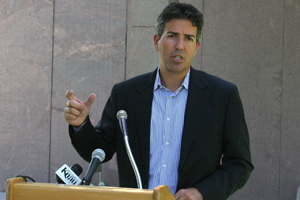
Wayne Pacelle, president/CEO, Humane Society of the US. (Photo by Lauren Saria/Cronkite News Service)

A ballot proposition promoted as a way to safeguard the right to fish and hunt in Arizona would politicize decisions about wildlife by giving the Legislature sole authority, leaders of a new campaign against the measure said Friday.

“It’s just one more bad idea from one of the most dysfunctional legislatures we’ve seen,” Sandy Bahr, director of the Sierra Club’s Grand Canyon Chapter, said at a news conference announcing the effort against Proposition 109.

Authored by Rep. Jerry Weiers, R-Glendale, and referred to voters by the Legislature, Proposition 109 would establish the “right to hunt, fish and harvest wildlife lawfully.” It would prohibit any law or rule that unreasonably restricts hunting or fishing.

It also would give the Legislature exclusive authority to enact laws regulating the manner, methods and seasons for hunting and fishing. Lawmakers could still delegate rule-making authority to the Arizona Game and Fish Commission, which currently establishes policy for hunting and fishing.

Calling their effort Arizonans Against the Power Grab, the state Sierra Club, The Humane Society of the United States and the Animal Defense League of Arizona filed paperwork Friday establishing a committee to oppose Proposition 109.

Wayne Pacelle, president and CEO of The Humane Society of the United States, said that giving lawmakers exclusive authority to make laws involving hunting and fishing would hinder the ability of citizens to put forward their own ballot initiatives, and not just on hunting and fishing.

“Today it’s wildlife,” Pacelle said. “But it could be any other cause in the future.”

Weiers didn’t respond Friday to a message left with the House Republican spokesman. Cronkite News Service was unable to reach representatives of hunting and outdoors groups that registered support for the measure.

Twelve other states include the right to hunt and fish in their constitutions, while Tennessee, South Carolina and Arkansas are voting on similar propositions this year, according to Arizona State University’s Morrison Institute for Public Policy.

Bahr called the ballot measure a “proposition in search of a problem” that would undermine a system that now uses science rather than politics to regulate hunting and fishing.

“The people of Arizona support animal welfare,” she said.

Some provisions of Proposition 109:

  • Declares hunting and fishing a constitutional right of Arizona citizens.
  • Specifies that wildlife belongs to the state and its citizens.
  • Gives the Legislature exclusive authority to enact laws to regulate hunting and fishing.
  • Allows the legislature to delegate rule-making authority to the state Game and Fish Commission.
  • Prohibits any law or rule that unreasonably restricts hunting or fishing using traditional means.
Enhanced by Zemanta

Scottsdale likely to bid on state trust land for preserve

[Source: Peter Corbett, azcentral.com]

Scottsdale is expected to be among the bidders next month for 2,000 acres of state trust land that has been appraised at $44.1 million.

The Arizona State Land Department has scheduled an auction Oct. 15 for the acreage in the Granite Mountain area of northern Scottsdale.

It is a desert area northeast of Troon North between the alignments of Lone Mountain Road and Dixileta Drive and roughly between 96th to 130th streets.

The property is zoned for single-family homes on lots of about 5 acres with other environmental restrictions.

Kroy Ekblaw, Scottsdale preserve director, said the city and the State Land Department have not had any contact with builders interested in bidding on the trust land.

The undulating terrain includes thick stands of desert vegetation, washes and exposed boulder outcropping, he said.

“There are challenges with development in bringing water and sewer services to the area,” Ekblaw said.

Scottsdale has long targeted the area for its McDowell Sonoran Preserve.

The city applied this summer for a grant from Arizona’s Growing Smarter conservation fund to split the cost of the state land, which is priced at $22,043 per acre.

Awaiting grant approval

Last month, the Conservation Acquisition Board, an advisory panel of the Arizona State Parks Board, recommended approval of a matching grant for Scottsdale of up to $25 million.

The Parks Board is scheduled to decide on the grant at its Sept. 15 meeting.

It also will decide on matching grants for Phoenix and Coconino County for land conservation through the Growing Smarter fund.

In a separate auction Oct. 15, Phoenix will be bidding for 1,139 acres of state trust land in northeastern Phoenix.

The parcel, appraised at $25.8 million, is between Lone Mountain and Dove Valley roads from Seventh to 24th streets.

Phoenix wants the land for its Sonoran Preserve. It is seeking to split the cost by acquiring a grant from the Growing Smarter conservation fund.

Coconino County wants funding to acquire the 2,249-acre Rogers Lake Preserve southwest of Flagstaff for $11.75 million.

That state trust land is up for auction Nov. 1.

Land fund may disappear

Scottsdale, Phoenix and Coconino County are tapping into the $123 million conservation fund before it potentially disappears.

If voters approve Proposition 301 on Nov. 2, the state will transfer what’s left of the conservation money to the general fund to balance its budget.

Conservation groups are opposing the raid on conservation funds. Voters approved the Growing Smarter initiative in 1998 to help communities buy land for conservation and to slow urban sprawl.

Scottsdale’s last acquisition for the McDowell Sonoran Preserve was in December when it paid $6.5 million at auction for 400 acres of state trust land north of DC Ranch.

The city has about 15,000 acres in the preserve with a goal to conserve 36,000 acres of desert and mountain terrain.

Enhanced by Zemanta