Does your child wonder how wild animals live and thrive in the Sonoran Desert?
Starting this fall, and continuing through the 2010-’11 school year, elementary school groups can arrange to visit Catalina State Park on the east edge of Oro Valley and participate in activities that teach how animals use the five senses to negotiate their environment.
The two-hour program is open to students in grades 1-3 from public, charter, private and home schools. Tours can be arranged by the classroom teacher, a release said. The entry fee is $2 per student.
Over the years, “thousands of Pima and Pinal county students have participated and enjoyed a morning of fun-filled learning activities in an Arizona state park,” the release continued.
REI of Tucson is helping to sponsor this program by providing trail stools for students to use while participating.
For more information, contact program coordinators Andrew and Joanne Hogan at 520-903-4367, e-mail AdventureCSP@aol.com, or go to the park website.
[You can also download Adventure Program Info HERE ( 807 KB PDF)]
Sandy Bahr (Cronkite News Service Photo by Rebecca L. McClay)
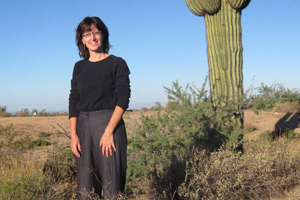
Sandy Bahr envisions this expanse of land near the McDowell Mountains remaining just as it is: a picturesque scene of large saguaros and desert brush.
Thanks to $23 million from a fund Arizona voters created in 1998 to preserve open spaces, Scottsdale plans to add about 2,000 acres of state trust land here to the McDowell Sonoran Preserve. To Bahr, director of the Sierra Club’s Grand Canyon Chapter, it’s money well spent.
But it could be one of the last such purchases receiving money from the Growing Smarter fund if voters approve a ballot measure in November.
The Legislature referred Proposition 301, also called the Land Conservation Fund Transfer, to have voters decide whether $123.5 million in state funds will be kept for preservation projects or siphoned into the general fund to balance the budget.
Bahr is among those opposing the measure, saying money for buying state trust land should stay intact.
“By redirecting these dollars, they hurt the local communities that were trying to conserve the land and they hurt conservation all over the state,” Bahr said. “They should keep their hands off it.”
It’s one of two proposals on the Nov. 2 ballot in which voters will have a direct say in how to balance the state’s fiscal 2011 budget, which took effect July 1.
The budget passed based on the assumption that voters would approve both Proposition 301 and Proposition 302, which would eliminate the First Things First early childhood health and development program. State law requires voter approval because voters created both programs.
Bahr said other measures like closing tax loopholes or scaling back spending in other departments are her preferred alternatives to balancing the budget.
Proponents of eliminating the Land Conservation Fund say the consequences of not balancing the budget – including the state receiving a downgrade on its debt rating from Moody’s Investors Service – are too severe to ignore. The downgrade from a Aa2 to Aa3 in July makes it more expensive for the government to borrow money.
“We can’t afford it,” said Sen. Steve Pierce, R-Prescott, who called the founding of the fund “well intended.” “We need the money many other places,” he said. “Buying open space is not high on the list of priorities.”
Rep. Rick Murphy, R-Glendale, said Arizona faces an unprecedented budget crisis.
“It is irresponsible to cut true necessities like public safety or basic K-12 education while continuing to spend money on non-essentials, no matter how good or important they might be,” Murphy said in an e-mail interview.
The Land Conservation Fund is administered by the Arizona State Parks Board. The money is allocated to communities on a dollar-for-dollar matching basis to purchase state trust land.
Proposition 301 opponents argue that the money, the only state funding source for land preservation, is critical for preserving the environment in the face of growth. They argue that unlike Proposition 302, Proposition 301 doesn’t have a provision that would require money taken from the fund to be used for a similar purpose.
Scottsdale has already received $3.3 million from the fund to help purchase a 400-acre parcel of land in the McDowell Mountain Regional Park, said Scottsdale Preserve Director Kroy Ekblaw, who didn’t take a position on the proposition.
“We have additional land we would like to acquire,” Ekblaw said. “If the revenue was available, we would certainly like to take advantage.”
Scottsdale could still purchase more land but not as much as if it had the matching funds, Ekblaw said.
Phoenix and Coconino County have also already applied to purchase state trust land parcels. According to a report from Arizona State University’s Morrison Institute for Public Policy, the applications could come to a halt if the measure passes.
Facts about Proposition 301 vote:
Key Provision: Would transfer to the general fund $123.5 million from Land Conservation Fund voters created in 1998 to preserve open spaces.
Trend: Along with Proposition 302, dealing with the First Things First early childhood development program, it would reallocate funds to shore up the state budget.
The Fund: Matches municipalities’ land conservation efforts dollar-for-dollar to purchase state trust land.
[Source: Arizona Outdoor News] – Two endangered species of native fish became the newest residents to the outdoor ponds at the Nina Mason Pulliam Rio Salado Audubon Center. Nearly 500 desert pupfish and 550 Gila topminnow were released yesterday into the center’s ponds as part of a program aimed at allowing private landowners to participate in the conservation of threatened and endangered species.
The Arizona Game and Fish Department is working to establish new populations of these fish at large, secure ponds in an effort to build up the populations for future stockings. The Audubon Center ponds are expected to produce thousands of topminnow and pupfish each year.
“Thanks in part to support from the Heritage Fund, we are working with our partners to re-establish these rare native fish across their historical range in Arizona,” says Jeff Sorensen, native fish and invertebrate program manager for the Arizona Game and Fish Department. “The fish we released this week should provide us with offspring that can be used to re-establish the species in new locations.”
The release was part of the Safe Harbor program that allows non-federal landowners to actively participate in the recovery of these endangered fish by providing sites to establish populations of the species in areas where it no longer exists. The Audubon Center is the tenth participant enrolled in the program. “Audubon Arizona is excited to provide a safe harbor for these native Arizona fish,” says Cathy Wise, Audubon Arizona education director [to read the full article, click here].
Suvoyuki Day has been set to start on Saturday. The event will be a celebration of Hopi culture and the archaeology of Homolovi State Park even though the park, like many Arizona state parks has been closed because of the lack of funding. The event will also be held in part at the Winslow Chamber of Commerce located in the historic Hubbell Trading Post Building at 523 West Second Street in Winslow.
Suvoyuki is a Hopi word meaning “joint effort.” The celebration will be in two parts, one in and near Winslow at the Hubbell Trading Post/Chamber of Commerce and Homolovi State Park and the other on the Hopi Reservation at Second Mesa.
Tours of Homolovi State Park will be conducted by archaeologist Rich Lange and will originate at the Hubbell Trading Post/Winslow Chamber of Commerce Building at 8:30 and 10:30 a.m. and 1 p.m. The Hubbell Trading Post/Winslow Chamber of Commerce Building contains many exhibits worth seeing for tourists who have not been there recently. This building was the home of one of the oldest trading posts in the Southwest and was the home of the largest Navajo rug known to exist.
There will be a second day of the Hopi Culture celebration on Sunday at Second Mesa. Plans for this event have not been announced but last year there was a race early in the morning at Second Mesa followed by tours of the mesa, displays of art by Hopi artists and traditional food. There are charges for this part of the celebration but details regarding charges and events are not yet known.
Persons wishing to attend the Suvoyuki Day events are advised to use their own vehicles for the tour of Homolovi State Park. It should be noted that the tour will be accessible by wheelchair.
As Homolovi State Park is officially closed, attendees are to be aware that they may visit the park only during the tours and must not stray from their group.
Anyone seeking more information is encouraged to call the Winslow Chamber of Commerce at (928) 289-2434 for more details. It is possible that more may be learned of the Second Mesa part of the celebration on Sunday may also be learned.

 Starting this fall, and continuing through the 2010-’11 school year, elementary school groups can arrange to visit Catalina State Park on the east edge of Oro Valley and participate in activities that teach how animals use the five senses to negotiate their environment.
 807 KB PDF)]