Sandhill cranes benefit from Heritage Fund

Arizona’s winter sandhill crane population has boomed from about 4,000 in the late 1970s to more than 34,000 today, in large part because of the state’s Heritage Fund.

Money from the Heritage Fund has secured ideal habitat for the birds in southeastern Arizona. Voters created the fund in 1990 and authorized Game and Fish to use Arizona Lottery dollars to support wildlife conservation. The fund gets as much as $10 million annually. Game and Fish doesn’t get any state general fund money.

“One reason for the increasing number of cranes in the Sulfur Springs Valley is the availability of prime wetland habitat that the birds require and that the Game and Fish Department has provided,” said Mike Rabe, a migratory bird biologist with the Arizona Game and Fish Department. “Cranes that used to fly south to Mexico now stop in Arizona because of those habitats.”

The impressive increase in sandhill cranes is good news for wildlife enthusiasts. Seeing hundreds or even thousands of cranes take to the skies, feed in the fields or come in to land is a thrilling sight. Adult sandhill cranes can have wingspans of 6-7 feet and stand five feet tall.

The Heritage Fund’s direct impact on wildlife conservation is compounded by the economic benefit that wildlife viewing has on communities across the state, especially in rural areas.

The city of Willcox estimates that $60,000 to $80,000 comes into the local economy from hotel, gas, restaurant, and other related purchases just during Wings over Willcox, an annual four-day bird viewing event. Two state wildlife areas – the Willcox Playa Wildlife Area near Willcox and the Whitewater Draw Wildlife Area near Douglas – offer visitors good viewing facilities, including bathrooms.

The Wings Over Willcox website at Wingsoverwillcox.com features maps of viewing sites and all kinds of information about sandhill cranes. The cranes migrate to southeastern Arizona in September and stay as late as March, with most of the birds present between November and February, according to the Wings Over Willcox site.

Sandhill crane viewing tips:

• The best viewing time is at first and last light when the cranes head out to feed, although it is possible to see them throughout the day during winter.

• Listen for the birds: They are very vocal and can often be heard before they are seen.

• Don’t forget your binoculars, spotting scopes, cameras and bird field guides.

For more information on wildlife viewing opportunities in the state, visit ww.azgfd.gov/wildlife.

For more information on the Heritage Fund and other state wildlife conservation programs, go online to azgfd.gov/w_c.

Communities applaud bid to revive Heritage Fund for historic projects

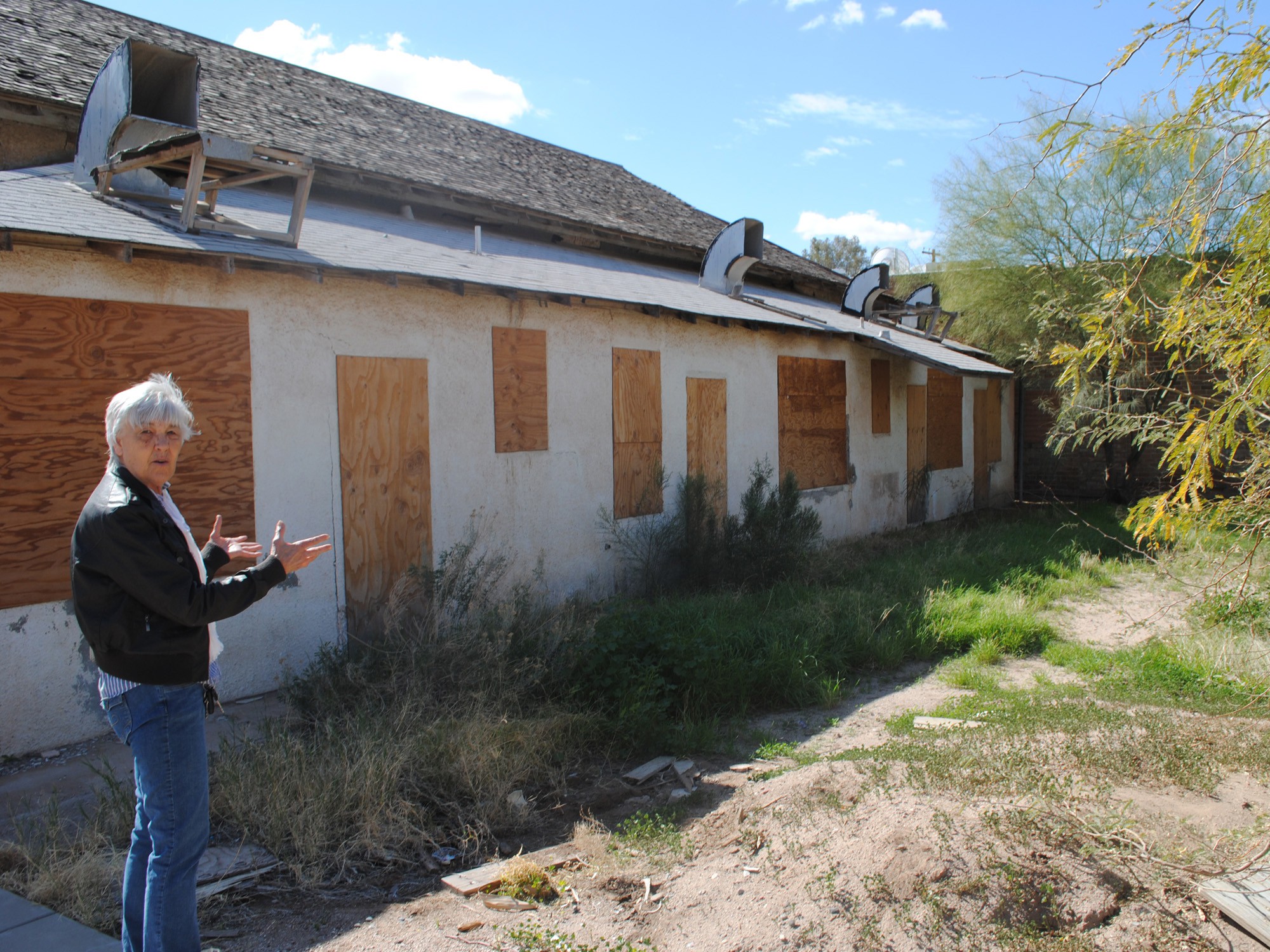
[Source: Jessica Testa, Cronkite News, 2/16/2012] – FLORENCE – To most people, these old buildings look like they’re decaying from the inside out. To Bonnie Bariola, they’re treasures, held up by century–old adobe brick and generations of hand-me-down stories. The Ceyla Long Sweeny Residence, built in 1876, is a small adobe house with manure for insulation and saguaro ribs for a roof. Bariola points to broken window, shattered by a tossed rock. A few blocks over, three dead pigeons lie just inside the entrance to the Cuen House and Butcher Shop, the first telephone exchange in Pinal County. Bariola fearlessly marches through as pigeons coo from the rafters.

Plans to restore the buildings won grants of more than $90,000 each through the Heritage Fund, which Arizona voters established in 1990. And both were stripped of that promised funding in 2009, when the state swept the Heritage Fund in an effort to balance its sinking budget.

In 2010, lawmakers eliminated the Heritage Fund, pulling the plug on dozens of approved, construction–ready projects, including five in Florence.

Bonnie Bariola, member of the Florence Preservation Foundation, wrote a grant for the restoration of the town's historic White House. Bonnie Bariola, member of the Florence Preservation Foundation, wrote a grant for the restoration of the town’s historic White House.

“Using Heritage funds, we’ve been able to maintain a part of history,” said Bariola, grant writer for the Florence Preservation Foundation. “Without funding, the culture of these buildings wastes away.” During the Heritage Fund’s 20–year run, Florence received more than $1.5 million in 18 state grants to restore its 19th century structures. The former mining community and Pinal County seat was third in the state for total dollars granted, behind Phoenix and Tucson.

Now, a state lawmaker is moving forward with a resolution that would put the Heritage Fund back on the ballot in November. If approved, the fund would be protected from any future sweeps thanks to the 1998 Voter Protection Act, a constitutional amendment that prohibits state lawmakers from reallocating any voter–created funds. “It’s fitting we do this, especially in our centennial year,” Rep. Russ Jones, R–Yuma, said recently to the House Committee on Agriculture and Water, which unanimously voted to support HCR 2047.

The Heritage Fund provided up to $10 million annually from the Arizona Lottery to both the Arizona Game and Fish Department and Arizona State Parks. Game and Fish used the money to promote outdoor recreation, help threatened and endangered species and educate residents about the environment and wildlife. Arizona State Parks used the fund for its own acquisitions and improvements and administered grants through programs benefiting historic preservation, trails and parks.

It’s not just Florence benefiting from the Heritage Fund – every city and town in Arizona has received the grant money, said Janice Miano, part–time executive director of the Arizona Heritage Alliance. “The impact is most noticeable in the rural counties, where any infusion of external funds for trail maintenance, land acquisition and construction repair will have a far larger impact to the relative population,” she said.

A Heritage Fund grant for $60,000 was canceled for a book on midcentury modern architecture published by the Phoenix Historic Preservation Commission. The city was able to shore up the money from federal grants to complete the project, and “Midcentury Marvels” will soon have its second printing.

Oro Valley wasn’t as fortunate. A $27,660 grant to build a dog park was canceled, along with a $111,160 grant to restore the 1874 Steam Pump Ranch. Ainsley Legner, director or Oro Valley’s Parks, Recreation, Library and Cultural Resources Department, said she’d be delighted to see Oro Valley residents be able to visit and use that land for recreation. “We don’t have any money available to improve the site. We can’t stabilize all the structures and provide the necessary amenities, like a restroom or a fire hydrant,” she said. “When you take away something as significant as Heritage funding, you can no longer pull all those resources together to make good things happen.”

Jay Ziemann, legislative liaison for Arizona State Parks, said the agency’s board supports Jones’ resolution but that his optimism is limited. Ziemann said many legislators share the views of Rep. Brenda Barton, R–Safford, who raised concerns in the committee meeting about the availability of lottery funds. A reinstated Heritage Fund would reduce the amount of revenue available to the Legislature. “It’s nice that it cleared that first step, but it’s got a long way to go,” Ziemann said. “I know it has a lot of hurdles ahead.”

Parks Heritage Fund, clearly a boon to Arizona, should be restored

[Source: William C. Thornton, Special to the Arizona Daily Star, 2/16/2012] – The Arizona Parks Heritage Fund may be the best investment of state lottery dollars you’ve never heard of. Enacted by voters in 1990, the Heritage Fund directed $20 million to be divided equally each year between State Parks and Game and Fish. It’s also worth noting that the $10 million state parks heritage fund money often served as seed money for matching grants. Thus the total yearly impact was typically $20 million or more.

Parks grants have developed new parks, and built and improved trails, campgrounds, picnic facilities, boat docks and ramps. Historical restoration grants have helped preserve important parts of our rich cultural heritage including our own beloved Mission San Xavier del Bac, the White Dove of the Desert.

If you hunt, fish, hike, camp, boat, picnic or share my love of Arizona history, the Parks Heritage Fund has benefited you. Moreover, the Parks Heritage Fund has helped fuel the economic engine that brings dollars and supports jobs.

A 2007 study estimated that 224 jobs were directly supported by Parks Heritage Fund grants. Heritage-funded improvements to parks and historic sites help attract more than 2 million visitors, about half from out of state, who add $266 million to our state’s economy each year and support an additional 3,000 jobs, mostly in rural areas that have been among the most heavily impacted by the economic downturn.

In response to the economic downturn and decline in tax revenue, the Legislature swept the state parks allocation into the general fund in 2010 and, inexplicably, eliminated the fund in July 2011.

Now, thanks to Rep. Russ Jones, a Republican from Yuma, voters may be given the opportunity to restore this fund, which has benefitted every community in our state. If enacted by the Legislature and approved by voters, HCR 2047 will reinstate language and lottery funding for the state parks heritage fund into Arizona law. (Editor’s note: Reps. Steve Farley and Matt Heinz, both Tucson Democrats, are also sponsors, as is Rep. Ted Vogt, a Tucson Republican.)

It passed its first committee hearing unanimously with strong bipartisan support, but many hurdles remain before it can be referred to voters. Reinstatement of the parks funding is not a partisan issue. It isn’t a liberal-conservative issue. It’s common sense and sound business practice, a win-win for outdoor recreation, historical restoration and Arizona taxpayers.

It’s our Heritage. Let voters decide.

Contact your lawmakers. Tell your representatives in the Arizona Legislature your views. Go to www.azhouse.gov or to www.azsenate.gov online. Call the Tucson legislative office at 398-6000 or call Phoenix toll-free at 1-800-352-8404.

William C. Thornton is a member of the board of directors for the Arizona Heritage Alliance. Email him at cactusworld@msn.com