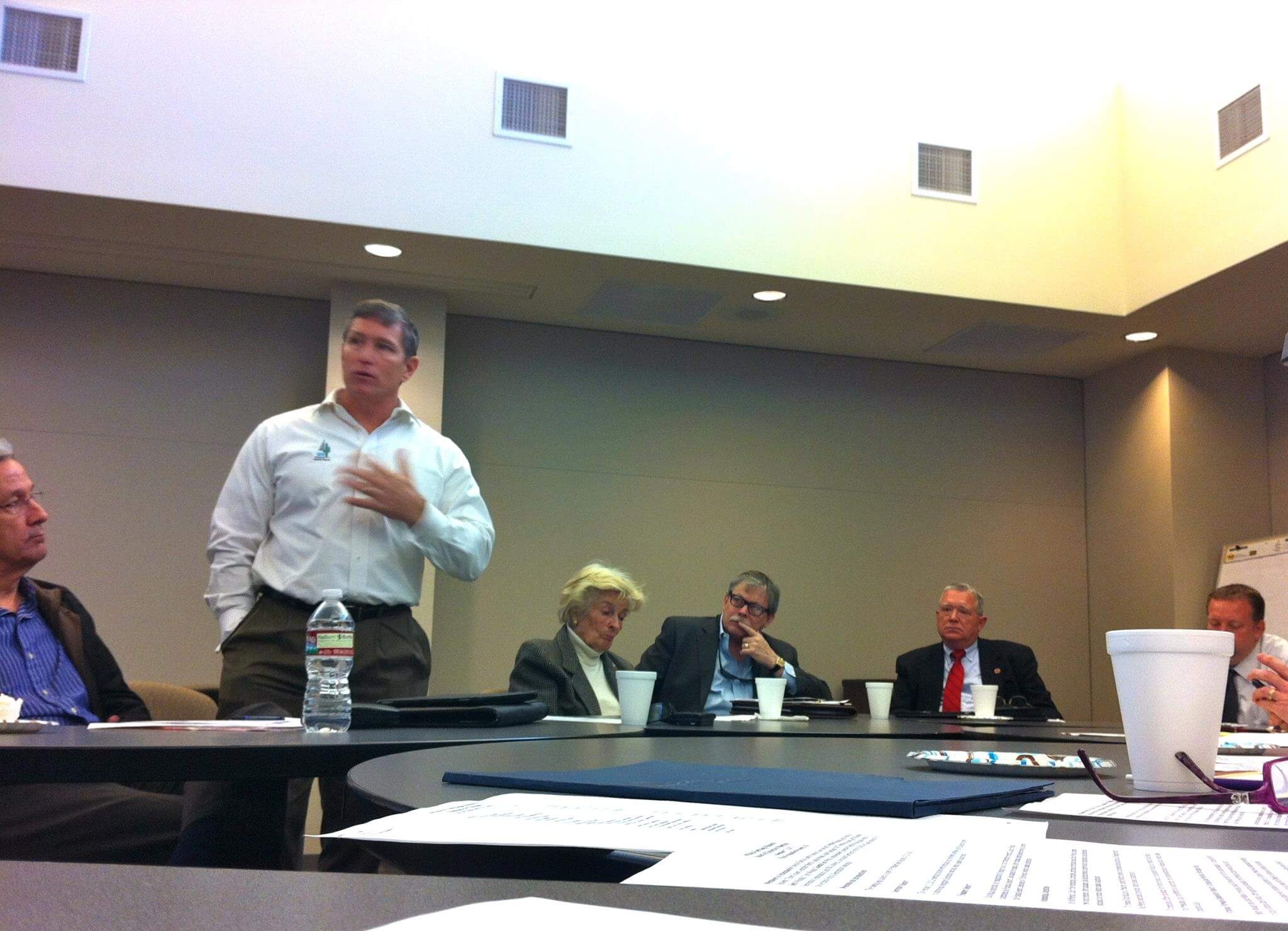
The “State of State Parks”

Bryan Martyn, Arizona State Parks Director, gave a detailed “state of state parks” update to the Arizona Heritage Alliance‘s board of directors this morning. — with Bob White, Barbra Barnes, Woody Wilson, Russ Jones and Peter Culp at Flinn Foundation on February 19, 2013.

Governor Jan Brewer Announces Appointments to State Parks Board

Governor Jan Brewer announced the appointments of Mark Brnovich and R.J. Cardin to the Arizona State Parks Board.

“Mark and R.J. are dedicated public servants with a diversity of experience that will benefit users of Arizona’s beautiful system of State Parks,” said Governor Brewer. “Mark is well-versed in the law, and has spent years working to help government operate more efficiently. R.J. has invested his career in parks and recreation, so he’s well-prepared to confront the challenges and opportunities facing State Parks. Together, both men will help ensure Arizona’s thirty state parks remain crown jewels for the people to enjoy.”

Since 2009, Mr. Brnovich has been Director of the Arizona Department of Gaming. Previously, he was an Assistant U.S. Attorney with the District of Arizona (2007-‘09); Senior Director of State Customer Relations for Corrections Corporation of America (2005-’07); Judge Pro Tem for the Maricopa County Superior Court (2004-’08); and Director of the Center for Constitutional Government at the Goldwater Institute (2003-’05); Assistant Attorney General (1998-2003); and Deputy County Attorney for the Maricopa County Attorney’s Office (1992-1998).

Mr. Brnovich earned his Juris Doctorate from the University of San Diego School of Law (1991), and graduated cum laude from Arizona State University with a bachelor’s in Political Science (1988).

Mr. Cardin’s career in parks and recreation spans 25 years. He has been Director of the Maricopa County Parks and Recreation Department since 2006, a role in which he is responsible for all facets of parks operations and development for the Nation’s largest regional park system.

Earlier, Mr. Cardin worked as: Deputy Director of Parks and Recreation for the City of Glendale (2001-’06); Director of Parks and Recreation for the City of Sioux City, Iowa (1998-2001); Chief of Park Operations (1998), Chief of Research and Marketing (1994-’98) and Recreation Planner (1991-’94) for Arizona State Parks; Research Assistant for the Department of Recreation Management and Tourism at Arizona State University (1989-’91); General Manager of the Ballard Golf and Country Club in Huxley, Iowa (1988-’89); and Manager of Operations at Sheldon Country Club in Sheldon, Iowa (1986-’88).

Mr. Cardin holds a Master of Science in Recreation Management and Tourism from ASU (1993), as well as a Bachelor’s of Science in both Recreation Management and Business Administration from Morningside College in Sioux City, Iowa (1987).
Mr. Brnovich joins the Arizona State Parks Board for a term that expires in January 2019; he replaces Tracey Jo Westerhausen. Mr. Cardin replaces William C. Scalzo on the Board, and will serve until January 2017. Both appointments require Senate confirmation.

State support is essential

[Source: Arizona Republic Editorial] – Budget cutting left the state’s park system seriously wounded. Now, Arizona has to decide if it will leave the parks bleeding. Will the next generation find the kind of robust park experience envisioned by Arizonans who supported state funding for parks with the 1990 Heritage Fund initiative and land acquisition through the 1998 Growing Smarter referendum?

That vision included public support to grow and enrich parks.Or will your grandchildren find a few remnants of an anemic system?

That could be the consequence of years of budget cuts to the state park system, which saw its funding slashed from about $54.7 million in fiscal 2008 to $25.7 million in the past fiscal year.

A report from the state Auditor General’s Office says the Parks Board “was established as a publicly funded agency to provide a system of state parks for the public to enjoy. The loss of state funding … created a need for the state parks system to transition from being publicly funded to paying for its own operating expenditures. However, park receipts have not been sufficient to cover park operating expenditures.”

There was no public outcry to “transition” the parks from state support. In fact, the public repeatedly has used the ballot box to express support for the parks and open spaces.

No wonder. The parks serve a variety of public interests.

Economic: A 2009 study by Northern Arizona University found that state parks visitors had a statewide impact of more than $266 million, plus an additional $22.8 million in state and local taxes. Parks help rural economies.

Recreational: State parks offer hiking, camping and other outdoor experiences.

Educational: Historic landmarks, such as Yuma Territorial Prison State Park, preserve Arizona’s colorful heritage.

Spiritual: Arizona is enriched by the grace, beauty and culture of state parks.

A robust park system says something positive about a state’s vision of itself and its future.

Some might argue that Arizona has plenty of federal land and national parks to satisfy its needs. But Kartchner Caverns, Catalina State Park, Picacho Peak or Tubac Presidio are special, uniquely Arizonan places that deserve state park status. Arizona’s 30 state parks are jewels worth keeping in the public trust for future generations — including your grandkids’.

Arizona’s budget was in deep trouble in 2008 and subsequent years. The Legislature and Gov. Jan Brewer had to make painful cuts. However, in 2010, alternatives were proposed to help keep the parks whole. A proposal for a vehicle-registration fee to provide long-term stable funding for the parks never made it out of committee.

Stonewalling that idea suggests some of our elected officials have philosophical reasons for wanting to limit public funding to the parks. But the voting public supports parks.

The auditor general’s report found that reduced funding, coupled with reduced visitation, create long-term risks for the sustainability of the parks. The report lays out some options for partnerships and other alternatives that are worth exploring.

But state support is essential.

Arizona must move beyond the crisis mentality of recession-era budgets and plan for a state park system worthy of Arizona’s amazing history and eye-popping natural heritage.

It’s time to heal the wounds inflicted on Arizona’s park system.

Audit: Arizona state parks need more funds, visitors

[Source: Yvonne Wingett-Sanchez, The Arizona Republic] – The future of Arizona’s state parks is at risk, a new audit says, and their long-term financial sustainability depends on expanded partnerships and marketing efforts.

An Auditor General’s Office report released Wednesday portrayed the parks system as in dire need of funding. The Legislature and Gov. Jan Brewer cut funding to about $25.7 million last fiscal year from about $54.7 million in fiscal 2008, the report said. The audit also found that low and declining visitation was among the factors that pose long-term risks for the parks. Auditors recommended the Arizona State Parks Board, which manages the state’s 30 parks, continue to expand partnerships with local governments and organizations and create a new marketing campaign to showcase the parks. Auditors also said the board should study how the parks system can become more financially sustainable.

The 30 state parks cover a total of 62,000 acres, with 28 percent of the land owned by the state and 72 percent leased or under easement from federal and state entities. There are four types of parks, ranging from environmental-education parks such as Boyce Thompson Arboretum to recreation areas such as Kartchner Caverns. About 2 million people visited the state parks in fiscal 2011, the report said.

Cristie Statler, executive director of the Arizona State Parks Foundation, said the audit results were no surprise given years of deep budget cuts to parks funding by the governor and lawmakers. “They swept entrance fees, gift-shop money, donations, as well as eliminated the $10 million annual Heritage Fund allocation to state parks,” she said. Statler pointed out that, time and again, surveys say Arizonans overwhelmingly support state parks and open spaces and believe such areas add to a region’s economic health. “The only reason we have state parks open right now is because partners around the state, municipalities and non-profits, have supported … a huge number of state parks — about 19 across the state,” Statler said. “Were it not for these partnerships — I kid you not — these parks would be closed.”

In some partnerships, for example, cities will agree to share certain park expenses. Statler said she understands the need to continue to expand such partnerships but questioned auditors’ recommendation of a marketing campaign. “If you don’t have money, how can you promote the parks?” she asked. “To admonish the state parks board or direct them to continue to expand partnerships is to relinquish any state responsibility for the state’s park system.”

The audit also found:

• Arizona has one of the lowest number of park visits among Western states, and state parks compete with many national and local parks for visitors.

• The loss of state funding for park operations has created a need for the system to transition from being supplemented from state coffers to earning enough revenue to cover its own operating expenses. Historically, park revenue has not covered operating expenditures, until recently.

• The board has taken steps to increase revenue, including adding electrical hookups at campsites, an improved reservations system and a new fee schedule that charges lower fees to attract campers during the off-season and higher fees when sites are at a premium.