
Political Committee Formed to Secure Passage of the Arizona Heritage Fund Ballot Referendum via HCR 2047 currently working its way through the Arizona House of Representatives

PHOENIX, Arizona (February 23, 2012) – Today, Arizona community leaders announced the formation of a political committee, Restore the Voters’ Heritage Fund, that will seek voter approval of a ballot referendum designed to support the Arizona State Parks Heritage Fund in acquiring and preserving recreational and historical assets across the state. The measure, which would go before the voters in the coming November election, is currently being considered by the Arizona Legislature.

HCR2047, sponsored by Representative Russ Jones (R-Yuma) and co-sponsored by a bipartisan group of 17 members of the House, would place a referendum on the November ballot seeking voter approval for the Arizona State Parks Heritage Fund.

“Pristine areas that represent the varied vistas, flora, and fauna found throughout Arizona, along with many important fragile sites, represent the heart and soul of our state,” Jones said. “It’s particularly important now, as Arizona celebrates its Centennial, that we rededicate ourselves to the preservation of our historical roots and spectacular vistas.”

The Arizona State Parks Heritage Fund was initially established in 1990 following the passage of a citizen-approved ballot initiative. As a result of the recent recession, however, the Legislature chose to redirect the dollars and remove that Fund from statute in order to close budget gaps.

The bill has already passed its first hurdle, gaining the unanimous 9-0 vote of the House Agriculture and Water Committee.

“In celebration of Arizona’s centennial there is nothing we could do that is more significant than to restore the one major tool our state has for preserving our special places,” said Phoenix lawyer Grady Gammage, Jr., Chairman of the committee that will seek voter support for the referendum this fall.

Richard H. Dozer, Chairman of GenSpring Family Office – Phoenix and former President of the Arizona Diamondbacks, is serving as Treasurer of the Committee. Looking back, he reflects, “The Heritage Fund has supported parks, trails, open space, jobs, and a better economy for Arizona in the past. We need it fully restored so that it continues that important work of preserving our rich history, beautiful landscapes, and our childrens’ strong minds and bodies. That is why I have agreed to support this campaign.”

One supporter of the restoration effort is Vicki Kilvinger, mayor of Florence, AZ. “From 1991 to 2006, Florence received a total of 18 grants totaling $1.5 million dollars, which was matched by the same amount for a total of over $3 million dollars,” said Kilvinger. “Our community and others across the state have been able to rehabilitate historic buildings utilizing the Fund. Passage of the referendum would re-establish a program that would create jobs in this difficult economy and also save historic properties, build parks, and contribute to a higher quality of life for our residents.”

According to Beth Woodin, President of the Heritage Alliance, a coalition is forming to support the referendum campaign. “The Heritage Alliance consists of organizations, companies and individuals in recreational, open space, historic preservation and conservation communities, as well as county and municipal governments,” Woodin said. “We already have thousands of activists across the state ready to hit the ground running, and we expect many other organizations also to join the cause.”

For more information, please contact: RestoreTheHeritageFund@cox.net. 
New Statewide Coalition Rallies For Parks and Open Space

[Source: Christie Silverstein, Arizona Forward, 2/21/2012] – A statewide coalition of business and environmental organizations rallied today at the State Capitol in support of legislation to bolster the financial condition of Arizona State Parks. The lead organizations were Arizona Forward, a statewide business association, and the Arizona State Parks Foundation, backed by 300 other business, environmental and community organizations. Arizona Forward was launched on Aug. 31 with the release of  “Why Parks and Open Space Matter – the Economics of Arizona’s Natural Assets,” a comprehensive examination of the status of Arizona efforts to preserve the outdoor environment. After releasing the primer, Arizona Forward was contacted by parks stakeholders around the state to help form an advocacy coalition.

The immediate purpose of the capitol rally is to show support for HB 2362, a bipartisan bill introduced by Rep. Karen Fann, R‐Prescott, with 22 other sponsors in the House and Senate. The bill would protect the income earned by state parks through entrance fees and other user charges from legislative budget sweeps. Brian Martyn, a Pinal County supervisor and Parks Foundation board member, said the Fann bill is vitally important to state parks in trying to meet business goals. “Like any business, state parks need incentives to meet its objectives, including the assurance that using best business practices will contribute to the financial success of the parks system,” said Martyn.

“That assurance is missing if the Legislature can sweep the income that parks earn.”

Other messages advanced by the coalition, Martyn said, include “the recognition that the Fann bill doesn’t solve the long‐term funding gap faced by state parks and we are working to convince legislators that state parks operations cannot stand any additional sweeps from its remaining revenue sources.”

Martyn noted that state parks are in precarious financial condition, causing a number of

parks to operate on reduced hours and others staying open only through temporary

contributions from local governments and friends groups. Kurt Wadlington, Tucson building group leader for Sundt Construction and chairman of Arizona Forward, said the parks report was validation of the business case for environmental prioritization. “We learned from statewide polling that nearly every Arizonan (93 percent) believes that parks and open space are essential to Arizona tourism, a $17 billion industry.”

“Other studies we reviewed showed that outdoor recreation attracts more than 5.5 million Arizonans, generating approximately $350 million in annual state taxes and nearly $5 billion in retail services while supporting 82,000 jobs,” he said. “Clearly, it is in every Arizonan’s interest to maintain a robust system of parks, open space and wildlife habitat and Arizona Forward is exploring long‐term solutions to funding that system,” added Wadlington.

Arizona lawmakers, businesses, residents to rally for state parks

[Source: Jimena Martinez, ABC15.com, 2/21/2012] – Arizona lawmakers, businesses, and residents will get the opportunity to rally for the 30 state parks and Natural Areas in the state.The Arizona State Parks Foundation is hosting Arizona State Parks Advocacy Day 2012 at the state capitol lawn Tuesday.

A newly-formed statewide coalition of business and environmental organizations will also rally forHB2362, which is a bipartisan bill that would protect state park revenues from legislative budget sweeps. The bill was introduced by Representative Karen Fann, R-Prescott.

The group has acknowledged that the legislation doesn’t provide a permanent solution for the financial problems facing state parks, but says it’s committed to identifying and securing a dedicated funding source for state parks. Just this month, it was announced that no state parks will be closing for the first time in two years as a result of state budget cuts.

Communities applaud bid to revive Heritage Fund for historic projects

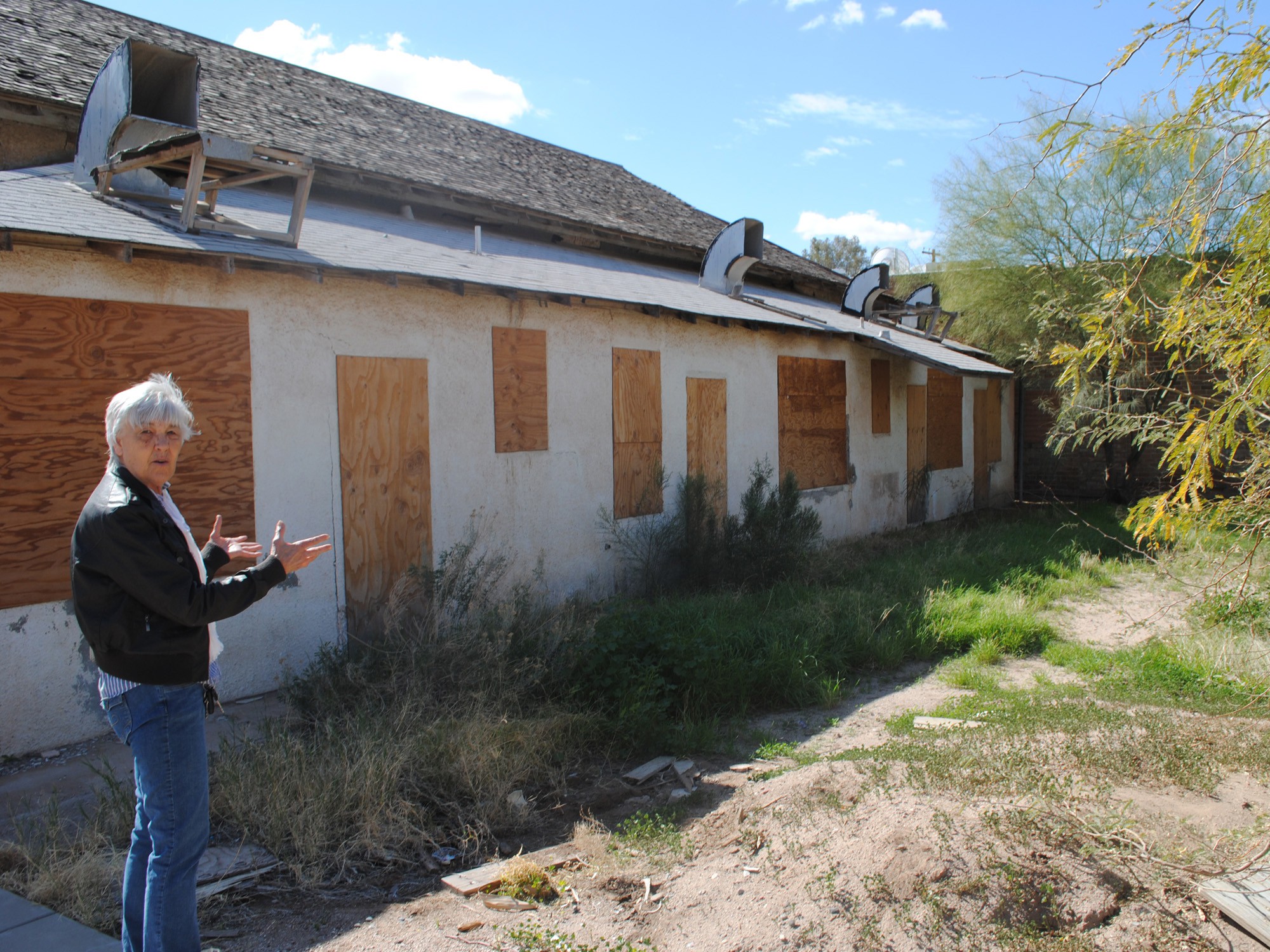
[Source: Jessica Testa, Cronkite News, 2/16/2012] – FLORENCE – To most people, these old buildings look like they’re decaying from the inside out. To Bonnie Bariola, they’re treasures, held up by century–old adobe brick and generations of hand-me-down stories. The Ceyla Long Sweeny Residence, built in 1876, is a small adobe house with manure for insulation and saguaro ribs for a roof. Bariola points to broken window, shattered by a tossed rock. A few blocks over, three dead pigeons lie just inside the entrance to the Cuen House and Butcher Shop, the first telephone exchange in Pinal County. Bariola fearlessly marches through as pigeons coo from the rafters.

Plans to restore the buildings won grants of more than $90,000 each through the Heritage Fund, which Arizona voters established in 1990. And both were stripped of that promised funding in 2009, when the state swept the Heritage Fund in an effort to balance its sinking budget.

In 2010, lawmakers eliminated the Heritage Fund, pulling the plug on dozens of approved, construction–ready projects, including five in Florence.

Bonnie Bariola, member of the Florence Preservation Foundation, wrote a grant for the restoration of the town's historic White House. Bonnie Bariola, member of the Florence Preservation Foundation, wrote a grant for the restoration of the town’s historic White House.

“Using Heritage funds, we’ve been able to maintain a part of history,” said Bariola, grant writer for the Florence Preservation Foundation. “Without funding, the culture of these buildings wastes away.” During the Heritage Fund’s 20–year run, Florence received more than $1.5 million in 18 state grants to restore its 19th century structures. The former mining community and Pinal County seat was third in the state for total dollars granted, behind Phoenix and Tucson.

Now, a state lawmaker is moving forward with a resolution that would put the Heritage Fund back on the ballot in November. If approved, the fund would be protected from any future sweeps thanks to the 1998 Voter Protection Act, a constitutional amendment that prohibits state lawmakers from reallocating any voter–created funds. “It’s fitting we do this, especially in our centennial year,” Rep. Russ Jones, R–Yuma, said recently to the House Committee on Agriculture and Water, which unanimously voted to support HCR 2047.

The Heritage Fund provided up to $10 million annually from the Arizona Lottery to both the Arizona Game and Fish Department and Arizona State Parks. Game and Fish used the money to promote outdoor recreation, help threatened and endangered species and educate residents about the environment and wildlife. Arizona State Parks used the fund for its own acquisitions and improvements and administered grants through programs benefiting historic preservation, trails and parks.

It’s not just Florence benefiting from the Heritage Fund – every city and town in Arizona has received the grant money, said Janice Miano, part–time executive director of the Arizona Heritage Alliance. “The impact is most noticeable in the rural counties, where any infusion of external funds for trail maintenance, land acquisition and construction repair will have a far larger impact to the relative population,” she said.

A Heritage Fund grant for $60,000 was canceled for a book on midcentury modern architecture published by the Phoenix Historic Preservation Commission. The city was able to shore up the money from federal grants to complete the project, and “Midcentury Marvels” will soon have its second printing.

Oro Valley wasn’t as fortunate. A $27,660 grant to build a dog park was canceled, along with a $111,160 grant to restore the 1874 Steam Pump Ranch. Ainsley Legner, director or Oro Valley’s Parks, Recreation, Library and Cultural Resources Department, said she’d be delighted to see Oro Valley residents be able to visit and use that land for recreation. “We don’t have any money available to improve the site. We can’t stabilize all the structures and provide the necessary amenities, like a restroom or a fire hydrant,” she said. “When you take away something as significant as Heritage funding, you can no longer pull all those resources together to make good things happen.”

Jay Ziemann, legislative liaison for Arizona State Parks, said the agency’s board supports Jones’ resolution but that his optimism is limited. Ziemann said many legislators share the views of Rep. Brenda Barton, R–Safford, who raised concerns in the committee meeting about the availability of lottery funds. A reinstated Heritage Fund would reduce the amount of revenue available to the Legislature. “It’s nice that it cleared that first step, but it’s got a long way to go,” Ziemann said. “I know it has a lot of hurdles ahead.”