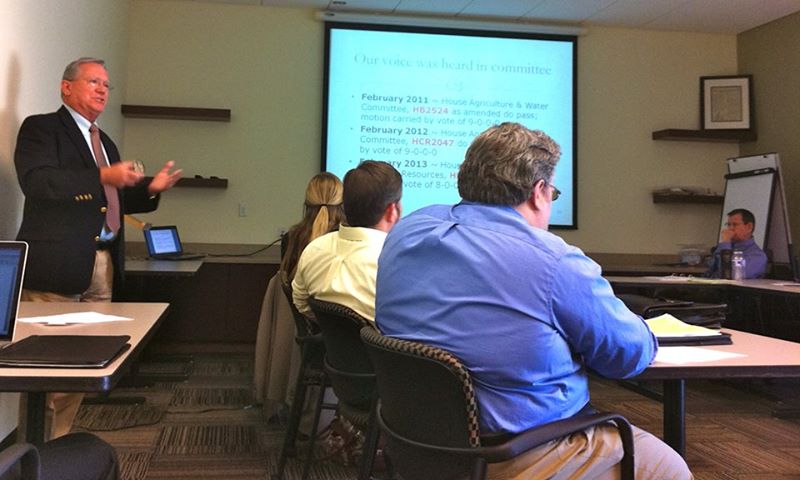
Heritage Fund creates jobs in rural areas: Arizona Heritage Alliance makes presentation to the Natural Resources Review Council

[Source: Bonnie Bariola, Florence Reminder] – The purpose of the Arizona Natural Resources Review Council (NRRC) is to protect state interests related to wildlife, land, water, and natural resources by actively engaging and countering federal encroachment on state authorities tasked with managing Arizona’s natural resources. It was established by Executive Order by Governor Jan Brewer on January 14, 2013.

The Executive Order stated the Council was to develop land and natural resource management strategies for Arizona and coordinate with state natural resource agencies and their existing management plans. Members of the Council include the directors of the following state departments: Game and Fish, Land, Environmental Quality, Water Resources, State Forester, Geological Survey, State Parks, and Agriculture. The chair is designated by the Governor and is currently Larry Voyles, director of the Arizona Game and Fish Department.

The Council was directed to prepare a comprehensive report and plan for the Governor for long-term land and natural resource management. The report should include and address multiple use and sustained yield approaches, public access issues, and sustainable economic development. In addition, the Council is to develop a coordinated and centralized Geographic Information System database model that identifies current and future management priorities for designated land and natural resource areas.

An additional request is for the Council to identify and prioritize legal, legislative, and incentive-based needs that protect and maintain state interests related to wildlife, land, water, and other natural resources. The governor also directed the Council to provide her with recommendations on a statewide approach to mitigation and conservation banking that includes state government, local governments, and the private sector in order to meet long-term natural resource conservation objectives.

The chair of the Council appointed a subcommittee to research and prepare results for each of the above directives. Prior to the Call to the Public at which time the Arizona Heritage Alliance was to make their presentation, each subcommittee chair gave a report on the status of their particular directive. It was amazing how much research the subcommittees have accomplished in six months. Chairman Voyles stated he wanted them to continue being aggressive with their research so they could have a final report to the governor as soon as possible.

Heritage Fund

The Heritage Fund presentation was made by Beth Woodin, the Arizona Heritage Alliance board president and Russ Jones, board member and former state representative. In 1990 the citizens of Arizona approved Proposition 200 with 62 percent support for the formation of the Heritage Fund in an amount of up to $20 million from the Arizona lottery with $10 million to be administered by Arizona State Parks and $10 million to be administered by the Arizona Game and Fish Department.

The distribution of the Arizona State Parks portion was:

·        35% – Local, Regional, and State parks

·        17% – Historic Preservation

·        17% – Acquisition and Development

·        17% – Natural Areas Acquisition

·        04% – Natural Areas Operation and Maintenance

·        05% – Environmental Education

·        05% – Trails

These monies supported: critical and endangered species and habitat, environmental education, historic preservation, non-motorized trails, and parks and recreation acquisition and improvements.

The Arizona Game and Fish monies were not touched by the Legislature and are used to:  

  • Conserve wildlife and maintain its habitat in areas surrounding cities;
  • Carry out wildlife research, surveys, and management of habitat for sensitive species;
  • Ensure access to public lands for outdoor recreation, sometimes by creating roads or trails;
  • Develop and maintain wildlife habitat projects at schools or adjacent areas for wildlife education;
  • Enhance or develop conservation/environmental school education programs;
  • Acquire habitat.

    The Arizona State Parks monies were used for:

  • Historic Preservation projects;
  • Hiking trails;
  • Picnic ramadas and park landscaping;
  • Ballfield lighting and improvements;
  • Playground equipment;
  •  Acquisitions and capital needs.

Heritage Fund for parks eliminated

In 2009 the Legislature swept the state parks portion of the Heritage Fund resulting in Arizona State Parks rescinding $6 million in Heritage Fund grants already awarded, leaving grantees with projects that were incomplete. Then, in 2010 the Legislature completely eliminated the State Parks Heritage Fund language from state statutes. As the result of the Arizona Heritage Alliance working with the Legislature, in February 2011, 2012, and 2013 the House Agriculture and Water Committee initiated and passed unanimously bills to reinstate the Arizona State Parks portion of the Heritage Fund. Unfortunately House Appropriations Chairman Kavanagh refused to hear these Heritage Fund Reinstatement Bills in his committee. which killed the bills.

In 2011, the Arizona Heritage Alliance and Arizona State Parks commissioned an Economic Impact Statement through the Arizona Hospitality Research and Resource Center at Northern Arizona University. Their study showed, among other benefits to Arizona, that direct expenditures from the State Parks Heritage Fund resulted in 125 direct jobs, 33 indirect jobs, and 66 induced jobs, for a total of 224 jobs per year, mostly occurring in rural areas of Arizona. This portion of the Heritage Fund created a tremendous economic impact to the state by promoting economic development, creating more jobs and heritage tourism, revitalizing historic sites and areas, and increasing property values.

The Arizona Natural Resources Review Council was then asked to recommend to Governor Brewer to reinstate the State Parks Heritage Fund, especially the grant program which supplied valuable programs and resources for both Arizona residents and visitors. The Council was also told the Heritage Fund provided economic, environmental, education, tourism and quality of life benefits that are too important to be lost.

Their presentation concluded with the following statement:  “If you hike, boat, ride, hunt, fish, watch wildlife, visit a park, or tour historic sites, then Arizona’s Heritage Fund affects your life.  We need to protect the Heritage Fund and improve it — not eliminate it!”

The Arizona Natural Resources Review Council’s meetings are open to the public. The meetings are usually held at the State Capitol Building but the June 25 meeting was held at the Arizona Game and Fish Department complex located on Carefree Highway in northwest Phoenix.

Arizona’s GOP lawmakers reject voluntary parks’ funding

[Source: Linda Valdez, azcentral Opinions] – Legislature to Arizona state parks: Take a hike.

Lawmakers gutted funding for Arizona parks during the recession. Times were hard. You might say they had no choice.

Today, they had a choice. And they rejected a park near you.

This morning, the GOP-controlled Senate voted down an amendment by Democratic Sen. Lynne Pancrazi to create an easy, voluntary way for Arizonans to boost parks’ funding.

Her plan would have allowed people to make a donation to state parks and roads at the same time they register their vehicles. Simple.

In rising to oppose the idea, Senate President Andy Biggs wondered “what else will we fund this way?”

Gee. I don’t know. The list would include a lot of other things our short-sighted Republican lawmakers decide not to fund – despite public support.

Pancrazi’s amendment might not be the ideal way to fund state parks. But it beats starving some of the most popular outdoor spaces in a state long known for its beauty.

Arizona’s GOP Lawmakers weaken the people’s powers

[Source: Linda Valdez, azcentral Opinions] –The Sierra Club’s Sandy Bahr told the Senate Appropriations Committee today that “the only way” Arizona will get meaningful environmental protections in the future is through the initiative process. She should know. She’s been up at the Legislature for years trying to get the conservatives who run the place to be nice to Mother Nature.

When Bahr took the podium to speak in opposition to a package of election law changes, committee chair Sen. Don Shooter, said: “Sierra Club? Are you worried we are going to chop up too many trees for ballots?”

Hardee-har-har.

The package of election bills – which has been contentious throughout the session – was tacked on to a Senate budget that emerged only this week. Democrats on the committee objected to the quickie budget in general — Sen. Anna Tovar said it would have been better to write a state budget in a “transparent, open process.” They also opposed the election changes.

Bahr’s call for transparency was aimed directly at the election changes. She said proposed changes in the initiative process do more than just move deadlines, they allow signatures to be thrown out on technicalities, such as whether the pages are submitted in the right order. They will create barriers.

The state Constitution gave voters the initiative/referendum process as a powerful tool and a check on Legislative power, Bahr said. Voters used the process to ban cockfighting, outlaw leg-hold traps, require humane farm animal practices, as well as to expand health care for the working poor, better fund education and create the Heritage Fund – which lawmakers gutted in a nasty slap at both voters and Mother Nature.

The Legislature should not put itself in charge of changing a system that was designed to give citizens the power to go around the Legislature. Any changes should come from a public discussion involving the interest groups that use, understand and value the initiative process. Not lawmakers who see it as a pain in the neck.

Bahr made valid points about the importance of preserving a process voters depend on to get around dunderheads in the Legislature. The dunderheads were unmoved.

All six Republicans on the committee voted for the election changes. All three Democrats voted no.

Rest in Peace Brian Pinney

RIP, you will be missed.
Brian Pinney

The Arizona Heritage Alliance is sadden by the death of their longtime fellow board member, Brian Pinney of Chandler. Pinney passed away on May 2, 2013 while turkey hunting near Show Low. He is survived by his wife, Laurie Pinney; daughters, Cari Carlson and Traci Pina; his son, Brian Pinney; five grandchildren, Ernie, Enthony, Elisa, Maximus, and Sydney. A memorial service was held May 13, 2013 at King Of Glory Church in Tempe.