
Rim Country legislators vow to reopen Tonto state park

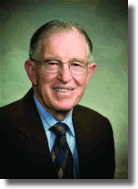
Jack A. Brown
State Rep. Jack Brown

[Source: Pete Aleshire, Payson Roundup] — The closure of Tonto Natural Bridge State Park this week provoked a flurry of public outrage, angry volunteers, muddled explanations, contentious meetings, collapsing budgets and blame-shifting lawmakers.  By the time the rhetorical smoke had cleared, all three of the Rim Country’s legislative representatives had sworn to push for the reopening of the park as soon as possible. However, they largely sidestepping blame for the draconian budget cuts that forced the state parks board to plan closure of more than half of its 27 parks — including the Rim Country park showcasing the world’s largest travertine arch.
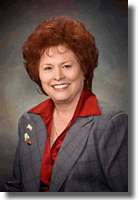
Sylvia Allen
State Senator Sylvia Allen

The action this week took place first at an overflow public meeting in Payson on Tuesday attended by representatives Jack Brown and Bill Konopnicki, followed by a vigorous arm-twisting session in the Phoenix office of Sen. Sylvia Allen on Wednesday.  The state parks board had unexpectedly closed Tonto Natural Bridge to shift staff to other parks while contractors do roof and structural repairs on an historic building that’s been leaking badly for so long that it has suffered structural damage. The three state lawmakers vowed to get the park open before summer either by pressuring the parks board to fence off the crumbling lodge during the $600,000 construction project or by postponing repairs.  They each denounced the parks board’s decision as “political,” but none directly addressed the impact of the legislature’s decision to take $34 million from various parks’ funds — nearly $30 million more than the general fund contributes to park operations.
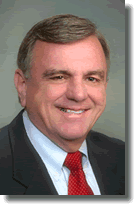
Bill Konopnicki
State Rep. Bill Konopnicki

Instead, the lawmakers criticized the parks board for “playing politics” by closing a popular, nearly self-supporting park like Tonto Natural Bridge, which draws about 90,000 visitors annually and contributes an estimated $3.5 million to the local economy.  “We have to get this park opened back up,” said Rep. Konopnicki (R-Safford) at the town meeting held at the Best Western Payson Inn, which drew an overflow crowd of 150. “I just can’t understand what the parks board was thinking … It’s politically motivated to make people yell at the legislature,” he said. [Note: To read the full article, click here.]

Newsweek magazine covers Arizona State Parks mess

[Source: Jessica Ramirez, Newsweek Magazine] — Ken Travous has spent the past month trying to get out of the red.  During a meeting with Arizona State Parks Board members Feb. 3, Travous, who serves as parks director, explained that statewide budget cuts would mean he’d have to close up to 11 state parks. The board naturally wanted to avoid such drastic measures and asked him to come back with “more options” for cutting $27 million.

Unfortunately, the options aren’t necessarily better.  Shutting down the parks would mean closing some of the oldest public lands in the state, a loss of about 31 jobs and roughly $50 million dollars in economic impact to the state. Plan B would mean asking employees to take furloughs, laying off up to 40 park workers, and cutting about $12 million in funds for community projects like local parks, trail developments, and historic preservation.  Without that funding, landscapers, carpenters, and plumbers hired by these communities would be out of work.  It’s this choice that made him feel like he’d been punched in the stomach every time he sits down at his desk.  “I have spent the last 23 years as the director of this state park system, building it up,” he says.  “Now I see it crumbling beneath my feet, and it makes me sick.”   [Note: To read the full article, click here.]

Arizona special election costs could exceed $11 million

Gov. Jan Brewer in her former role as Secretary of State, overseer of elections (Photo: Paul O'Neill, EV Tribune)

[Source: Jeremy Duda, Arizona Capitol Times] — Gov. Jan Brewer is asking the Legislature to put two items on the ballot for a special election that she believes would help close Arizona’s budget gap and revitalize the state’s economy.  But those proposals come with costs of their own.  The Secretary of State’s Office has drawn up three scenarios for special elections in which voters would decide whether to temporarily raise taxes and overhaul the Voter Protection Act of 1998.  The special election, if approved by the Legislature, could cost the state nearly $12 million… for a number of expenses, including the ballots, promotional literature, Election Day personnel, training, voter outreach, and early-ballot processing.

  • According to the Secretary of State’s Office, the first scenario, a regular November-style election, would be the most costly, with an $11.7 million price tag.  That option would require all polling places in the state to open on Election Day, with 120 days notice and a 33-day early-voting period.
  • The second option, modeled after presidential primaries, would cost about $8.3 million, with fewer polling places than the first scenario and a 15-day period for early voting.  That type of election would also require 120 days notice.
  • The final option, a mail-in ballot election, would have a 33-day early voting period, would require just 90 days notice, and would cost about $10.1 million.

Secretary of State Ken Bennett ordered his office to start examining the costs of a special election in February after media reports stated that Brewer would ask the Legislature to send a temporary tax increase proposal to the voters.  She made that request on March 4 in a speech before a joint session of the Legislature, asking lawmakers to either put the issue to a public vote or simply approve it themselves.  “I’m just trying to be prepared, knowing that that’s something they were at least thinking about,” Bennett said after the initial reports that Brewer would ask for a special election.

The governor also requested that the Legislature put another question to the voters, an overhaul of 1998’s Proposition 105, the Voter Protection Act.  Brewer said many of the funds that are protected by that proposition would be put to better use in bridging the $3 billion budget gap the state is expecting to face in fiscal year 2010.

Attend (or view) Arizona Game & Fish Commission meeting, March 6-7

The next meeting of the Arizona Game & Fish Commission is Friday, March 6 and Saturday, March 7, at the Arizona Game and Fish Department headquarters facility at 5000 W. Carefree Highway in Phoenix.  The Friday portion of the meeting begins with an executive session at 8 a.m., followed by the public session.  The Saturday portion of the meeting begins at 8 a.m.

The public is invited to attend the meeting at the Phoenix headquarters or view the meeting via a videoconference feed at any of the department’s regional offices.  The department successfully initiated a pilot videoconference program last month and has improved and expanded the system so that the videoconference feed will go to all six regional office locations in Pinetop, Flagstaff, Kingman, Yuma, Tucson and Mesa.  For a list of office addresses, click here.

Those viewing the meeting at the regional offices will be able to submit “blue slips” to present oral comment on the “call for comment” portions of the agenda, just as if they were attending the meeting in person.  To view a copy of the meeting agenda, click here and click on the “commission agenda” link.